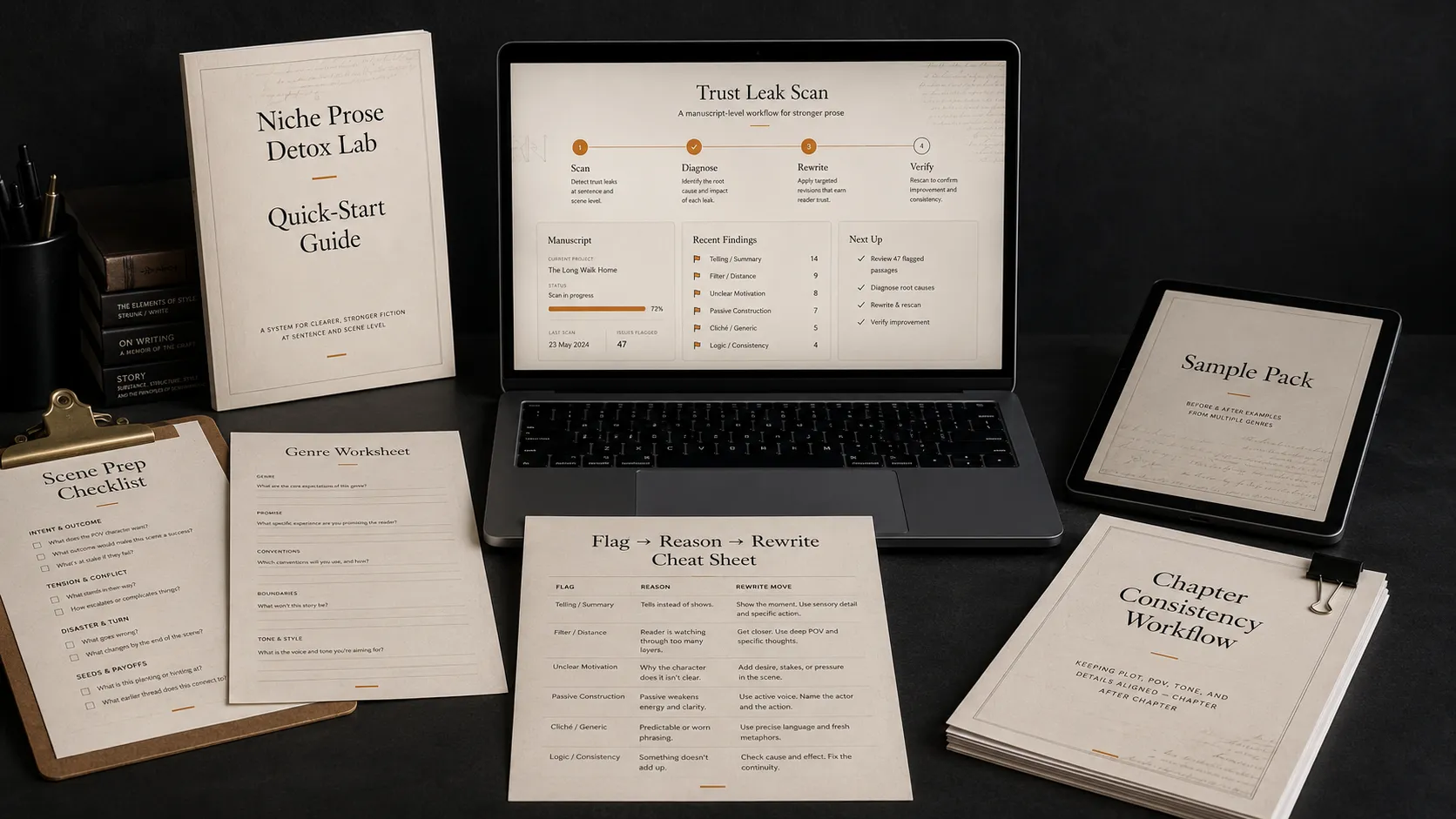
Niche Prose Detox Lab Swipes
Affiliate note: Full funnel commission is 50% across FE + Order Bump + all OTO/DS offers.
Replace every `[YOUR LINK]` with your WarriorPlus affiliate link before posting.
Price note: Launch price starts at $12.95 and rises over time.
Email Swipes
Complete 5-email sequence for a 7–10 day send. Replace CTA placeholders with your checkout or sales link.
Email #1 — Your Scene May Not Be the Problem
Hi {{first_name}},
A beta reader finishes your scene and says:
“Something feels off.”
Not broken.
Not confusing.
Just… off.
So you open the document and start revising.
You tighten the dialogue. Cut two paragraphs. Rewrite the ending. Smooth every sentence that sounds remotely suspicious.
An hour later, the scene is cleaner.
It is also flatter—and somehow less like you.
Here is what may have happened:
The whole scene was not the problem.
It may have contained only three or four polished, empty lines that caused the reader to distrust everything that came after them.
I call this a Trust Leak.
A Trust Leak is a sentence that looks technically correct but feels generic, over-explained, emotionally abstract, or disconnected from the established voice.
For example:
“The silence wrapped around her like a second skin, heavy with everything neither of them dared to say.”
Nothing is grammatically wrong.
But the familiar metaphor and abstract emotional summary could belong to almost any character in almost any story.
A reader feels the distance—even when they cannot identify the exact sentence causing it.
That is why rewriting the entire scene is so expensive.
You are trying to repair 1,500 words when the problem may be hiding in three sentences.
Niche Prose Detox Lab was built to find those exact lines first.
You paste one scene. The Lab flags specific Trust Leaks, explains why each line may weaken reader trust, and leaves the final editorial decision to you.
No automatic full-scene rewrite.
No claim that your prose was “63% AI-generated.”
Just:
Exact line → named signal → reason → your decision.
[Find the lines that are leaking trust — $12.95 →] [YOUR LINK]
One payment. No subscription. Instant access.
Nhan
Founder, Niche Prose Detox Lab
P.S. You do not have to agree with every flag. A flag is not a verdict. You decide whether to keep, change, or ignore each line.
Email #2 — “Make It Sound Human” May Be Making It Worse
Hi {{first_name}},
When a scene feels too polished or strangely anonymous, the obvious solution is to paste it into an AI assistant and ask:
“Make this sound more human.”
The result is often smoother.
The sentences become cleaner.
The rhythm becomes more consistent.
The awkward edges disappear.
Unfortunately, those awkward edges may have been part of your voice.
The AI fixes the suspected problem by rewriting everything around it.
That creates a new problem:
You still do not know which lines were weakening the scene.
And now you have to compare two full versions—your original and the smoother, more anonymous rewrite.
Niche Prose Detox Lab uses the opposite order:
Flag first. Rewrite second.
First, it points to the exact line.
Then it names the pattern, such as:
Polished abstraction · Emotion-telling · Cliché clusters · Hedge inflation · Rhythm flattening · Voice drift · Genre-contract misses
Then it explains why the line may matter.
Only after that can you request a controlled alternative—and only for the lines you approve.
For example:
Flagged line
“He seemed to almost sense that something was somewhat wrong with the hallway, as if the quiet itself might be watching him.”
Signal
Hedge inflation.
Reason
The softeners—“seemed,” “almost,” “somewhat,” and “as if”—delay the threat and weaken the POV’s certainty.
Optional controlled rewrite
“The hallway held its breath. He didn’t.”
The whole scene stays intact.
The beat stays intact.
You decide whether the sharper version fits your character—or whether the original should remain.
That is the difference between handing your scene over for another rewrite and using AI as a line-level diagnostic assistant.
[Scan first. Rewrite only what you approve →] [YOUR LINK]
Niche Prose Detox Lab is $12.95, one time, with no subscription.
Nhan
P.S. It works inside your own ChatGPT account. Free ChatGPT works; a paid plan is optional for higher usage limits and is not included with the product.
Email #3 — The Most Dangerous Trust Leaks Look Fine
Hi {{first_name}},
The easiest weak sentences to revise are the obviously clumsy ones.
The dangerous lines are the ones that look completely fine.
Consider this fantasy example:
“Mira understood that the council’s decision would reshape the balance of power across the northern holds, and that her silence now would be interpreted as consent.”
The sentence is clear.
The grammar works.
The information matters.
But it may still create a Trust Leak.
Why?
Because the prose briefly leaves Mira’s body and shifts into explanatory narrator voice.
Instead of experiencing the political pressure through Mira, the reader receives a summary of what the situation means.
The line explains the stakes rather than dramatizing them.
A controlled alternative might be:
“If she stayed quiet, the council would count her with them. Mira kept her mouth shut anyway.”
Same decision.
Same political consequence.
Closer to the character’s immediate experience.
But here is the important part:
The Lab does not declare the first version objectively wrong.
Perhaps your narrator intentionally uses greater distance.
Perhaps the explanatory style matches the rest of the book.
Perhaps you simply prefer the original.
You can reject the flag.
That editorial control is central to Niche Prose Detox Lab.
It is not trying to turn every sentence into short, sharp, minimalist prose.
It is trying to show you where a reader may feel a change in voice, specificity, emotional distance, rhythm, or genre promise—so you can make the decision consciously.
Your options remain:
Keep it.
Rewrite it yourself.
Request a controlled alternative.
Ignore the flag.
That is safer than allowing a generic “humanize this” prompt to rewrite an entire passage before showing its reasoning.
[See the exact lines before changing the scene →] [YOUR LINK]
$12.95 one time. Instant access.
Nhan
P.S. The Lab is designed specifically around romance, thriller, and fantasy scenes, including a genre-contract check based on the subgenre you provide.
Email #4 — Find the Weak Lines in About 15 Minutes
Hi {{first_name}},
You probably already own writing PDFs you intended to read “someday.”
That is why Niche Prose Detox Lab is not designed like a course.
There are no modules.
No homework.
No requirement to read the entire revision kit before touching your manuscript.
You begin with one live scene—the one you trust least.
Here is the first-session workflow:
Minute 1–3
Open the Quick-Start Guide and choose a scene of roughly 1,000–2,000 words.
Minute 4–6
Use the Scene Prep Checklist to provide the POV, subgenre, scene purpose, and essential context.
Minute 7–10
Paste the scene into the Lab and run the Trust Leak scan.
Minute 11–15
Review the exact flagged lines and decide whether to: Keep the line · Rewrite it yourself · Request a controlled alternative · Ignore the flag
By the end of that first session, you should have a clearer answer to one question:
Is the problem spread across the whole scene—or hiding in a few sentences?
Your purchase includes:
Niche Prose Detox Lab — The diagnostic engine that flags exact lines and explains the signals.
Quick-Start Guide — Run your first scene without learning prompt engineering.
Scene Prep Checklist — Give the Lab enough context to reduce noisy or misleading flags.
Seven-Signal Revision Cheat Sheet — Understand what each named signal means.
Genre Contract Worksheet — Define what your specific romance, thriller, or fantasy scene needs to deliver.
Diagnostic Sample Pack — See examples of lines that were kept, changed, or deliberately ignored.
What to Ignore Guide — Protect intentional repetition, unusual phrasing, narrator distance, and deliberate voice.
Continuity Protection and Offline Backup — Use the process chapter by chapter, with PDF and TXT references.
The practical value of the full package is listed at $110.
The current price is:
$12.95. One payment. No subscription.
[Get the complete Lab and revision kit →] [YOUR LINK]
Nhan
P.S. Start with the Quick-Start Guide, Scene Prep Checklist, and Lab. Open the other resources only when you reach the decision they support.
Email #5 — Let One Real Scene Decide
Hi {{first_name}},
You should not decide whether Niche Prose Detox Lab works by reading another sales claim.
Run it on one real scene.
Choose the scene that:
A beta reader said felt “off” · Became too smooth after AI polishing · No longer sounds completely like you · Keeps pulling you into another full rewrite
Then use the complete workflow once:
Prepare the context.
Run the Trust Leak scan.
Review the exact lines and reasons.
Keep, rewrite, or reject each flag.
You are not looking for a perfect score.
You are not looking for proof that a passage was written by AI.
You are looking for one practical result:
Can the Lab point to specific sentences that deserve your attention—without rewriting everything that already works?
That is the One-Scene Test.
If the Lab cannot reveal anything useful—or you simply decide the process is not for you—email nhanscope@gmail.com within 30 days for a full refund.
No questions asked.
Your purchase includes immediate access to the Niche Prose Detox Lab Custom GPT and the complete revision kit in both PDF and TXT formats.
You run the Lab inside your own ChatGPT account.
We do not host your manuscript.
Free ChatGPT works. A paid subscription is optional and is not included.
The price is $12.95 one time.
That is less than the cost of spending another writing afternoon rewriting 1,500 good words because three sentences felt wrong.
[Run the One-Scene Test — get instant access for $12.95 →] [YOUR LINK]
Find the sentences.
Keep the story yours.
Nhan
Founder, Niche Prose Detox Lab
P.S. Before your next beta, agent submission, or Kindle sample, run the scene you trust least. Let the actual lines—not another vague “something feels off”—tell you what to revise.
Article & YouTube Outlines
5 article outlines + 5 YouTube outlines — educate first, sell second. CTA placeholders: [YOUR LINK].
Part 1: Article Outlines
Article 1 — Why Your AI-Polished Fiction Sounds “Off”
Core promise: Help fiction writers understand why technically correct prose can still feel generic, hollow, or disconnected from the character’s voice.
Hook: You paste a scene into an AI assistant and ask it to make the writing smoother. The result is clean, grammatical, and polished—but your beta reader says something still feels wrong. The problem may not be the entire scene. It may be three or four sentences that no longer sound like they belong to your character, narrator, or story.
1. “Correct” Prose Is Not Always Convincing Prose — Grammar, clarity, and polish do not automatically create believable narrative voice. Readers respond to specificity, rhythm, emotional distance, and character perspective.
2. What Happens During AI Polishing — AI may replace unusual wording with familiar phrasing, smooth irregular rhythms, add emotional explanations, introduce common metaphors, and shift from character experience to narrator summary.
3. The Trust Leak Problem — Define a Trust Leak as a sentence that appears polished but feels generic, empty, over-explained, or disconnected from the established voice. A few Trust Leaks can make readers question the prose that follows.
4. Common Signs of a Trust Leak — Polished abstraction · Emotion-telling · Cliché clusters · Hedge inflation · Rhythm flattening · Voice drift · Genre-contract misses
5. Why Rewriting the Whole Scene Is Risky — Full-scene rewrites can remove strong lines, flatten character voice, and create unnecessary revision work.
6. A Better Workflow: Flag First, Rewrite Second — (1) Identify the exact suspicious line. (2) Name the pattern. (3) Explain why it affects the scene. (4) Decide whether the line should stay. (5) Rewrite only when necessary.
7. Example
Original: “The silence wrapped around her like a second skin, heavy with everything neither of them dared to say.”
Analysis: Familiar metaphor + abstract emotional summary instead of something specific to observe.
Controlled alternative: “She counted three breaths before he looked up. Neither of them filled the quiet.”
Emphasize: the writer may still keep the original.
Conclusion: The goal is not to remove every polished sentence or avoid AI completely. The goal is to know which lines weaken reader trust before rewriting everything around them.
CTA: Niche Prose Detox Lab flags exact Trust Leak lines, explains why they matter, and offers optional line-level alternatives only when you request them. [Run the One-Scene Test →] [YOUR LINK]
Article 2 — Stop Asking AI to “Make It Sound Human”
Core promise: Show writers why vague humanizing prompts often produce generic rewrites and provide a safer line-level workflow.
Hook: “Make this sound more human” sounds reasonable—but the model does not know which parts already sound like you, so it often rewrites the strong lines along with the weak ones.
1. Why the Prompt Is Too Vague — “Human” is not a precise stylistic target. It may push informality, shorter sentences, contractions, emotional language, variation, and familiar sensory details—none of which automatically preserve the author’s voice.
2. Rewrite-First Versus Diagnosis-First
Rewrite-first: changes the whole passage, hides the original problem, makes comparison difficult, may introduce a different voice.
Diagnosis-first: isolates exact lines, explains the concern, protects strong prose, keeps the writer in control.
3. Seven Questions to Ask Before Rewriting — (1) Emotion explained instead of dramatized? (2) Metaphor specific to this character? (3) Too many hedges? (4) Rhythm unnaturally uniform? (5) Sounds like established POV? (6) Fulfills genre promise? (7) Unusual phrasing intentional?
4. Example of Hedge Inflation
Original: “He seemed to almost sense that something was somewhat wrong with the hallway, as if the quiet itself might be watching him.”
Controlled alternative: “The hallway held its breath. He didn’t.”
5. When Not to Accept the Rewrite — Deliberate ambiguity, narrator distance, repetition, and genre conventions may trigger false or unhelpful flags.
6. The Recommended Workflow — Paste one scene → add POV and subgenre → request exact flagged lines → require reasons before rewrites → review one line at a time → keep, edit, rewrite, or reject.
Conclusion: AI should not make the final editorial decision. Its best role is to help you notice patterns you may have become too familiar with to see.
CTA: Use Niche Prose Detox Lab to scan one real scene before your next full rewrite. [Find the lines before changing the scene →] [YOUR LINK]
Article 3 — Seven Signs Your Fiction Is Losing Its Voice
Core promise: Help writers identify seven specific prose patterns that may make a scene feel anonymous or unconvincing.
Intro: Voice loss rarely announces itself with one obviously terrible sentence. More often, the scene becomes slightly smoother, safer, and less specific with every revision.
Sign 1: Polished Abstraction — Sounds meaningful but gives nothing concrete. Ex: “An unbearable sadness filled the space between them.”
Sign 2: Emotion-Telling — Explains feeling instead of revealing via action/perception/dialogue. Ex: “She realized she was deeply afraid of losing him.”
Sign 3: Cliché Clusters — Familiar phrases stacked together feel assembled. Ex: heart pounding · breath caught · silence like a blanket · eyes darkening · time standing still
Sign 4: Hedge Inflation — “Seemed,” “almost,” “somewhat,” “perhaps,” “a little” accumulate and weaken perception.
Sign 5: Rhythm Flattening — Every sentence similar in length, structure, and intensity. Irregular rhythm often carries personality and tension.
Sign 6: Voice Drift — Prose stops sounding like the POV character and becomes a neutral explainer.
Sign 7: Genre-Contract Misses — Thriller softens urgency · Romance explains attraction without intimacy · Fantasy summarizes world politics outside the character’s experience
Important note: A signal is not a verdict. Intentional style can resemble every one of these signals. Identify the pattern to support judgment, not replace it.
Conclusion: A strong diagnostic process does not ask “Is this AI writing?” It asks “What is this line doing to the reader’s trust, immersion, and experience?”
CTA: Niche Prose Detox Lab checks one scene for seven named signals and attaches the reasoning to specific lines. [Run a Trust Leak scan →] [YOUR LINK]
Article 4 — How to Revise a Scene Without Rewriting Everything
Core promise: Give writers a repeatable 15-minute method for diagnosing a scene before committing to a full rewrite.
Intro: A scene can feel wrong because the story beat is weak, POV is unclear, pacing is slow, or a few lines are generic. These need different solutions—rewriting everything first wastes time and may damage what already works.
Step 1: Choose the Scene You Trust Least — ~1,000–2,000 words. Candidates: vague beta feedback, heavily AI-polished, no longer sounds like you, keeps triggering repeated revisions.
Step 2: Write Down the Scene Contract — POV · Subgenre · Scene purpose · Emotional turn · Reader expectation · Essential context
Step 3: Separate Story Problems From Prose Problems — A line-level tool cannot repair missing conflict, weak characterization, or plot structure.
Step 4: Flag Specific Lines — Do not request a full rewrite. Ask for exact lines connected to named patterns.
Step 5: Require a Reason for Every Flag — Useful reasons explain effect on voice, tension, specificity, emotional distance, or genre promise.
Step 6: Make One of Four Decisions — Keep · Edit yourself · Request an alternative · Reject the flag
Step 7: Read the Scene Again — After changing only selected lines, check whether the original problem remains.
15-minute schedule: 1–3 select · 4–6 prepare context · 7–10 run diagnostic · 11–15 review and decide
Conclusion: The most efficient revision is not always the biggest. Sometimes the best result comes from protecting 1,497 words and changing three.
CTA: Use the Niche Prose Detox Lab One-Scene Test to diagnose one real scene before rewriting it. [Start your first scene →] [YOUR LINK]
Article 5 — AI Detector vs. Stylistic Diagnostic Tool
Core promise: Explain why authorship detection and stylistic diagnosis are different—and why writers benefit more from actionable line-level reasoning.
Intro: A score such as “63% AI-generated” may sound precise. But what should a fiction writer actually change? The number does not identify the line, explain the reader experience, or protect intentional style.
1. What an AI Detector Claims to Do — Estimates whether text resembles machine-generated output. Do not present detectors as definitive proof.
2. What a Stylistic Diagnostic Tool Does — Evaluates how prose reads, not who produced it. May flag: generic phrasing, emotional abstraction, excessive hedging, rhythm uniformity, POV inconsistency, genre mismatch.
3. Why Authorship Is Not the Useful Editing Question — A human-written line can still sound generic. An AI-assisted line can still be vivid. The editing question is whether the line works inside the scene.
4. Scores Versus Reasons — “Your scene received a score of 74” vs. “This line contains four softeners that delay the threat and weaken the POV’s certainty.” The second gives something observable to evaluate.
5. Why False Flags Are Acceptable When Transparent — A useful tool lets the writer inspect the reason and reject the conclusion.
6. The Writer Keeps the Final Call — The tool does not prove authorship, replace an editor, or guarantee improvement.
Conclusion: Fiction writers do not need another mysterious percentage. They need exact lines, clear reasons, and control over every revision.
CTA: Niche Prose Detox Lab is a stylistic review system—not an AI detector. [See the line-level workflow →] [YOUR LINK]
Part 2: YouTube Video Outlines
Video 1 — Why AI-Polished Fiction Sounds Wrong (8–10 min)
0:00–0:30 Hook: “Have you ever used AI to polish a scene, read the result, and thought: technically, this is better—but somehow it no longer sounds like me? The problem may not be your entire scene. It may be three sentences leaking reader trust.”
0:30–1:15 Intro: Beta readers sense generic prose but cannot name the lines. Promise: by the end, know what a Trust Leak is, how to spot one, and why rewriting the whole scene may make it worse.
1:15–2:30 What Is a Trust Leak? Define the term. One polished but empty sentence can change how readers judge what follows.
2:30–4:00 Example Breakdown: “The silence wrapped around her like a second skin…” — familiar metaphor, abstract emotional summary, lack of character-specific observation. Alternative: “She counted three breaths before he looked up. Neither of them filled the quiet.” Original is not automatically wrong.
4:00–6:00 Three Common Causes: Polished abstraction · Emotion-telling · Voice drift — one short example each.
6:00–7:00 The Wrong Fix: “Make this sound human” often yields a full-scene rewrite; risk of losing good lines and distinctive rhythm.
7:00–8:30 Better Workflow: Flag exact line → name signal → explain effect → keep, edit, rewrite, or reject.
8:30–9:15 Product: Niche Prose Detox Lab scans one scene, points to Trust Leak lines, explains reasoning before any rewrite.
9:15–End CTA: Run it on the scene you trust least. One-Scene Test includes 30-day refund. [YOUR LINK]
Video 2 — Stop Using “Make It Sound Human” (7–9 min)
0:00–0:25 Cold open: “‘Make it sound human’ might be one of the most dangerous prompts a fiction writer can use—not because the result is always bad, but because the model does not know which parts already sound like you.”
0:25–2:00 Why the Prompt Fails: Ambiguity of “human.” Model may shorten sentences, add contractions, increase emotional language, replace unusual phrases, smooth rhythm.
2:00–3:30 Before-and-After: Short fictional paragraph. Rewrite improves surface smoothness but removes character-specific language.
3:30–5:00 Rewrite-First vs. Diagnosis-First: On-screen comparison. Rewrite-first changes everything / hides source / forces full-passage compare. Diagnosis-first isolates lines / gives reasons / protects strong prose / keeps control.
5:00–6:30 Better Prompt Structure: Exact lines only · Named patterns · Reasons before rewrites · Optional alternatives · No full-scene overwrite
6:30–7:30 When to Reject: Intentional repetition, narrator distance, unusual rhythm, genre conventions.
Product: Niche Prose Detox Lab turns that diagnostic process into a fixed, repeatable workflow.
CTA: Do not ask AI to humanize the whole scene. Find the lines first. [YOUR LINK]
Video 3 — Seven Signs AI Editing Flattened Your Voice (10–12 min)
Hook: “Voice loss does not always sound robotic. Sometimes it sounds polished, professional, and completely forgettable.”
Setup: Cover seven signals; none is automatically a mistake.
Signals 1–7 (definition + example + revision question each): Polished Abstraction · Emotion-Telling · Cliché Clusters · Hedge Inflation (“He seemed to almost sense…”) · Rhythm Flattening (read two paragraphs aloud) · Voice Drift (leaves POV → narrator explanation) · Genre-Contract Misses (one romance, one thriller, one fantasy)
Disclaimer: “A flag is not a verdict. Your style may use one of these patterns intentionally.”
Summary: Show all seven signals on screen.
Product: Niche Prose Detox Lab checks these patterns on specific lines and explains why each flag may matter.
CTA: Run one scene. Keep the flags that help. Reject the ones that do not. [YOUR LINK]
Video 4 — Fix a Scene in 15 Minutes (8–10 min)
Hook: “If a scene feels wrong, your first move should not be to rewrite it. Your first move should be to identify what kind of problem you actually have.”
1. Choose the Right Scene: 1,000–2,000 words — vague feedback, heavily polished, no longer feels like you, revised repeatedly.
2. Prepare Context: POV · Subgenre · Scene purpose · Emotional turn · Essential context
3. Line-Level Review: Exact lines + clear patterns. Do not request a new version of the entire scene.
4. Review Reasoning: What pattern? What reader effect? Does it matter here? Is the style intentional?
5. Four Decisions: KEEP · EDIT · REQUEST AN ALTERNATIVE · REJECT
6. Read Again: Review the whole scene after only selected changes.
15-min timeline: 1–3 select · 4–6 prepare · 7–10 scan · 11–15 decide
Product: Exact first-session workflow inside Niche Prose Detox Lab.
CTA: Test it on one real scene before your next full rewrite. [YOUR LINK]
Video 5 — AI Detector vs. Useful Fiction Feedback (7–9 min)
Hook: “Suppose a tool tells you your scene is 63% AI-generated. What exactly are you supposed to revise?”
1. Problem With a Score: A number does not identify the weak line, stylistic pattern, reader effect, or appropriate revision.
2. Authorship vs. Reader Experience: A human can write generic prose. An AI-assisted sentence can still be specific and effective.
3. Actionable Feedback: “This paragraph sounds AI-generated” vs. “This sentence contains four hedges that weaken the POV’s certainty and reduce tension.”
4. Why Reasons Matter: Transparent reasoning lets the writer agree, disagree, or revise selectively.
5. What a Stylistic Tool Cannot Do: Prove authorship · Replace an editor · Fix plot/character arcs · Guarantee every flag is correct · Guarantee better reviews or sales
6. What It Can Do: Isolate suspicious lines · Name recurring patterns · Explain possible reader effects · Offer optional line-level alternatives · Help protect strong prose
Product: Niche Prose Detox Lab is not an AI detector. It is a stylistic review workflow built for fiction writers.
CTA: Use the One-Scene Test. Let a real scene—not an AI percentage—decide whether the process helps. [YOUR LINK]
Facebook / Google Ad Starters
6 Facebook ads · Google RSA headlines/descriptions · ad groups · sitelinks · callouts · retargeting. Replace Final URL with your sales page.
Part 1: Facebook Ad Starters
FB Ad 1 — “Something Feels Off”
A beta reader says, “Something feels off.”
They cannot identify the lines—so you rewrite the entire scene.
But the problem may not be the whole scene.
It may be three or four polished, empty sentences that make readers distrust everything that follows.
Niche Prose Detox Lab helps you find those exact lines first.
Paste one fiction scene and receive:
✓ Specific Trust Leak flags
✓ Clear reasons attached to each line
✓ Optional line-level alternatives
✓ No automatic full-scene rewrite
Keep the line. Change it yourself. Request an alternative. Or reject the flag.
You keep the final editorial call.
FB Ad 2 — The Trust Leak Mechanism
Every sentence can be grammatically correct—and the scene can still feel strangely anonymous.
The cause may be a Trust Leak:
A polished but generic, hollow, over-explained, or voice-breaking line that makes readers question the prose that follows.
Common Trust Leak signals include:
• Polished abstraction
• Emotion-telling
• Cliché clusters
• Hedge inflation
• Rhythm flattening
• Voice drift
• Genre-contract misses
Niche Prose Detox Lab attaches named signals and reasons to specific lines.
It does not claim to prove who wrote the passage.
It shows how the prose may read—and lets the writer decide what stays.
FB Ad 3 — Stop Asking AI to “Humanize” Everything
“Make this sound more human.”
It sounds like a useful fiction-editing prompt.
But the AI does not know which lines already sound like you.
So it may rewrite the strong sentences along with the weak ones—making the scene smoother, safer, and more anonymous.
Niche Prose Detox Lab uses the opposite workflow:
Flag first.
Explain the reason.
Rewrite only when requested.
The Lab isolates exact lines that may be weakening voice, tension, specificity, or genre promise.
No blind full-scene overwrite.
No mysterious AI percentage.
Just specific lines, visible reasoning, and your decision.
FB Ad 4 — Demonstration Ad
Consider this line:
“The silence wrapped around her like a second skin, heavy with everything neither of them dared to say.”
It sounds polished.
But the familiar metaphor and abstract emotional summary may make the line feel as though it belongs to no particular character.
That is a possible Trust Leak.
A controlled alternative might be:
“She counted three breaths before he looked up. Neither of them filled the quiet.”
Same scene beat.
More concrete experience.
No need to rewrite the entire scene.
The original is not automatically wrong.
A flag is not a verdict.
Niche Prose Detox Lab shows the line, names the pattern, explains the possible reader effect, and lets you decide.
FB Ad 5 — Product and Offer
You are not buying one clever AI answer.
You are buying a revision process you can reuse whenever a scene feels “off.”
Get instant access to:
✓ Niche Prose Detox Lab Custom GPT
✓ Quick-Start Guide
✓ Scene Prep Checklist
✓ Seven-Signal Revision Cheat Sheet
✓ Genre Contract Worksheet
✓ Diagnostic Sample Pack
✓ What to Ignore Guide
✓ Continuity Protection and Offline Backup
✓ PDF and TXT formats
Paste one scene of roughly 1,000–2,000 words.
See exact flags and reasons.
Request optional alternatives only for the lines you approve.
$12.95 one time.
No subscription.
Instant access.
FB Ad 6 — One-Scene Test
Do not decide whether this works by reading another sales claim.
Run it on one real scene.
Choose the scene that:
• A beta reader said felt “off”
• Became too smooth after AI polishing
• No longer sounds completely like you
• Keeps pulling you into another rewrite
Use Niche Prose Detox Lab to identify specific lines, examine the reasons, and decide what stays.
If the Lab does not reveal anything useful—or the process is simply not right for you—request a full refund within 30 days.
That is the One-Scene Test.
The scene gives the verdict.
Part 2: Google Responsive Search Ad
RSA Campaign 1 — Headlines & Descriptions
Headlines (≤30 chars):
1. Find the Lines That Feel Off
2. Stop Rewriting the Whole Scene
3. Protect Your Fiction Voice
4. Flag First. Rewrite Second.
5. Find Hidden Trust Leaks
6. Fix Three Lines, Not 1,500
7. AI-Polished Scene Feels Off?
8. Keep the Story Yours
9. Line-Level Fiction Review
10. See Exact Flags and Reasons
11. Built for Fiction Writers
12. One Scene. Clearer Answers.
13. Your Voice, Your Final Call
14. Diagnose Before You Rewrite
15. Niche Prose Detox Lab
Descriptions (≤90 chars):
1. Paste one scene. See exact Trust Leak flags and reasons before rewriting anything.
2. Protect your voice with line-level review and optional rewrites you approve.
3. Get the Lab plus the full revision kit for $12.95. One payment. Instant access.
4. Run the One-Scene Test. If it is not useful, request a refund within 30 days.
Ad Group 1 — Fiction Voice
Find generic, hollow, or voice-drift lines without rewriting your entire scene.
Review exact lines and reasons. Keep, change, or reject every suggestion.
Ad Group 2 — AI Fiction Editing
A fixed fiction-review workflow that flags specific lines before offering rewrites.
No authorship score. No automatic overwrite. You make every editorial decision.
Ad Group 3 — Scene Revision
Paste a 1,000–2,000-word scene and see where the Trust Leaks may be hiding.
Protect what already works. Revise only the lines that deserve your attention.
Ad Group 4 — Product and Price
Get the Custom GPT plus Quick-Start, checklists, samples, and offline guides.
Instant access for $12.95 with a 30-day One-Scene Test refund policy.
Google Sitelinks
How the Lab Works — Flag exact lines before rewriting. / See named signals and reasons.
What Is Included — Custom GPT plus revision guides. / PDF and TXT versions included.
See Example Results — Review flag-to-rewrite examples. / See which lines stay unchanged.
One-Scene Test — Run the Lab on one real scene. / Thirty-day refund policy.
Google Callout Extensions
One-Time Payment · No Subscription · Instant Access · Line-Level Review · Optional Rewrites · Writer Keeps Control · PDF and TXT Included · 30-Day Refund · Built for Fiction · Not an AI Detector
Short Retargeting Ad Starters
Retargeting Ad 1 — Find the Lines First
Still thinking about the scene that feels “off”?
Do not rewrite all 1,500 words yet.
Paste the scene into Niche Prose Detox Lab and identify the exact lines that may be leaking reader trust.
Retargeting Ad 2 — Keep the Good 1,497 Words
A vague beta comment can cost an entire revision afternoon.
The problem may be hiding in three sentences.
Run the One-Scene Test before your next rewrite.
Retargeting Ad 3 — Your Voice. Your Final Call.
Niche Prose Detox Lab does not rewrite your whole scene.
It flags specific lines, explains the reasoning, and waits for your decision.
One payment. No subscription. Instant access.
Product Box Graphics
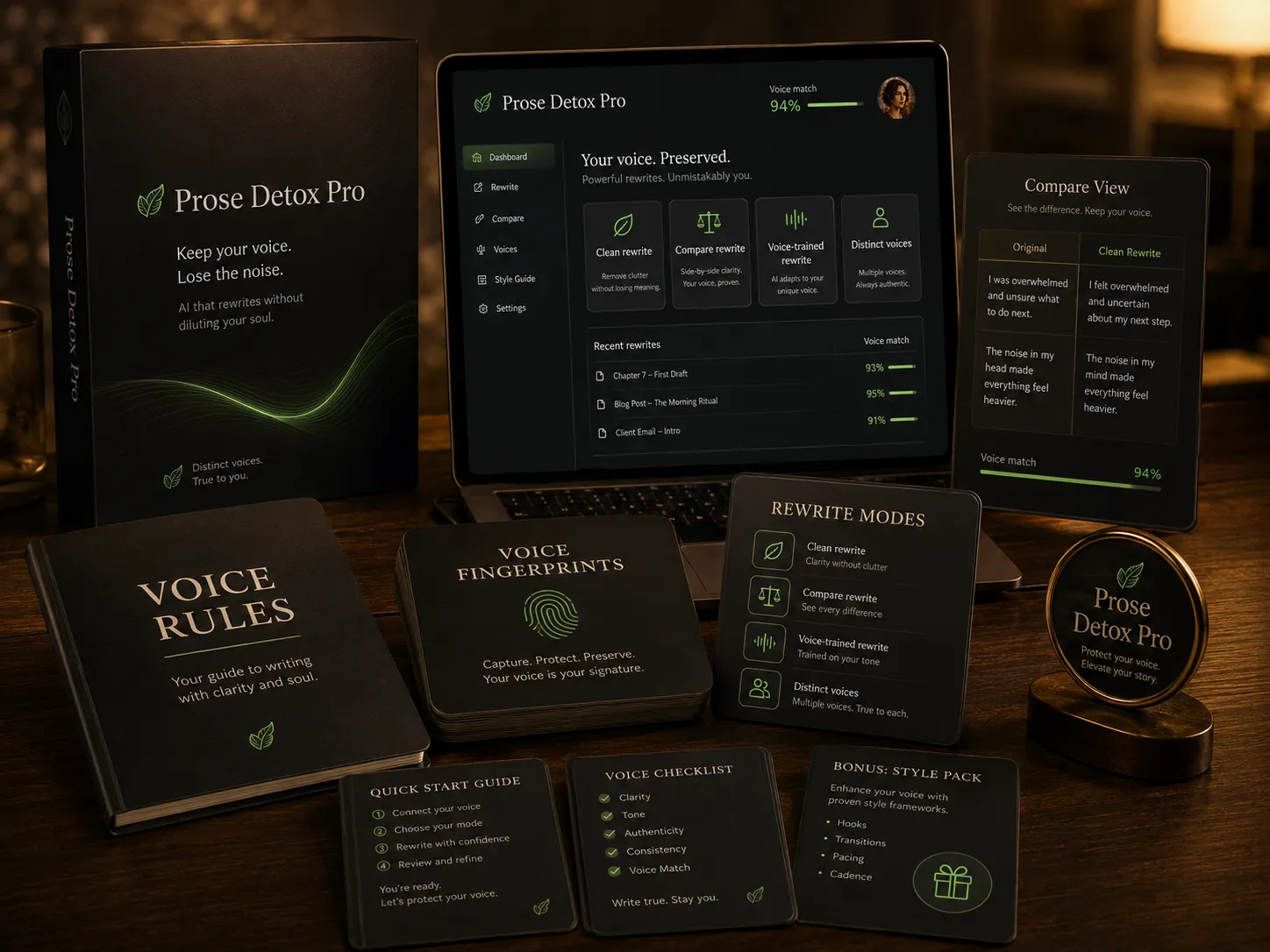
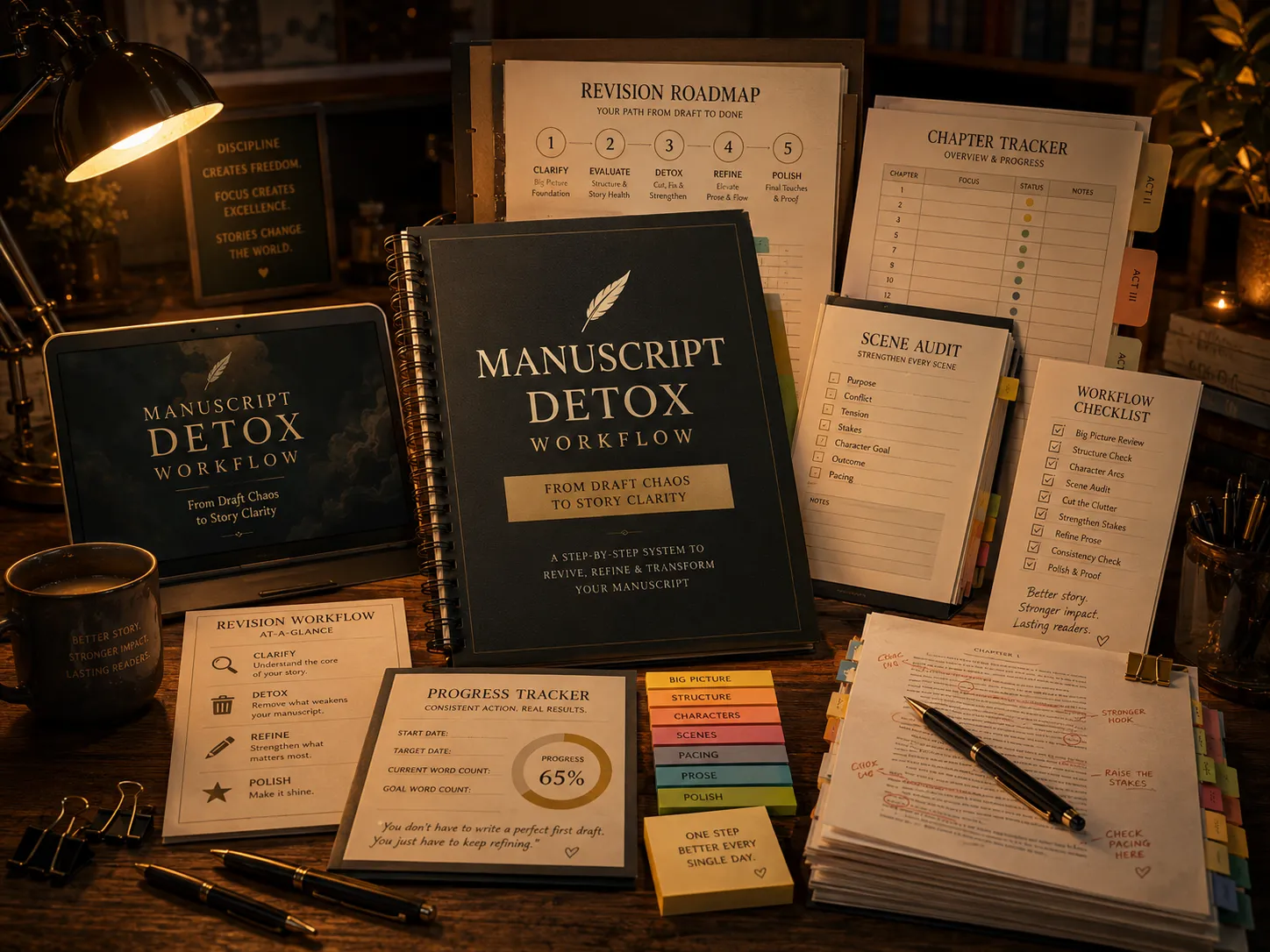
Launch Angles
12 launch angles · recommended day-by-day sequence · core messages · short hook bank.
Angle 1 — The “Something Feels Off” Problem
Core idea: Writers get vague feedback like “something feels off,” but nobody identifies the exact sentences. The product turns an unclear feeling into specific, reviewable lines.
Supporting: A scene may not need a complete rewrite. It may contain only three to five polished, generic, or voice-breaking lines that change how readers experience everything that follows. The Lab isolates those lines and explains why they may be weakening reader trust.
Sample launch copy:
Your beta reader says: “Something feels off.”
So you reread the scene, cut paragraphs, rewrite dialogue, and polish every sentence that looks suspicious.
Two hours later, the scene is smoother—but it sounds less like you.
The problem may never have been the entire scene. It may have been three sentences.
Niche Prose Detox Lab helps you find those exact lines before you rewrite everything around them.
Angle 2 — Fix Three Lines, Not 1,500 Words
Core idea: Saves revision time by helping writers avoid unnecessary full-scene rewrites.
Supporting: When the source of a problem is unclear, writers revise too broadly. The Lab narrows the decision to exact lines, reasons, and optional alternatives.
Sample launch copy:
A vague beta comment can cost an entire writing afternoon. You rewrite the opening. Then the dialogue. Then the emotional beat. But the original problem may have been hiding in only three lines.
Niche Prose Detox Lab helps you protect the parts that already work. Paste one scene. Review the exact Trust Leak lines. Change only what deserves your attention.
Angle 3 — Flag First, Rewrite Second
Core idea: Most AI writing tools rewrite too early. This product diagnoses before suggesting changes.
Supporting sequence: (1) Identify the line. (2) Name the signal. (3) Explain the reader effect. (4) Let the writer decide. (5) Rewrite only when requested.
Sample launch copy:
Most AI editing begins with a rewrite. Niche Prose Detox Lab begins with a question: Which exact line is weakening the scene—and why?
The Lab flags first. It explains the reasoning. Then you choose whether to keep the line, edit it yourself, request an alternative, or reject the flag.
No blind full-scene overwrite. No loss of control.
Angle 4 — Protect Your Fiction Voice
Core idea: AI polishing can make prose smoother while removing the irregularities that make the writer’s voice distinctive.
Supporting: Helps identify voice drift without standardizing the whole scene. Can leave deliberate repetition, unusual phrasing, narrator distance, and genre conventions untouched when the writer decides they belong.
Sample launch copy:
The danger of AI polishing is not always bad prose. Sometimes the result is clean, readable, and completely anonymous. The rhythm becomes safer. The language becomes more familiar. The scene stops sounding like the person who wrote it.
Niche Prose Detox Lab helps you identify where that voice drift may have started—without rewriting the strong lines that still sound like you.
Angle 5 — Stop Asking AI to “Make It Sound Human”
Core idea: The common “make it sound human” prompt is too vague and often creates a different generic voice.
Supporting: The AI does not know which sentences are already personal, intentional, or character-specific. Diagnosis-first gives more control than a vague full-passage rewrite.
Sample launch copy:
When you ask AI to “make this sound human,” it has to guess what “human” means. Shorter sentences? More contractions? Stronger emotions? More sensory language?
The model may improve the surface while replacing your voice with another polished default.
A better workflow is: Exact line. Named problem. Clear reason. Optional rewrite. Your decision.
Angle 6 — The Trust Leak Mechanism
Core idea: Introduce “Trust Leak” as the unique mechanism behind prose that feels polished but unconvincing.
Supporting: A Trust Leak is a line that feels generic, emotionally abstract, over-explained, or disconnected from the established voice. A handful of lines can be enough to create doubt.
Sample launch copy:
Readers do not need proof that AI touched a scene. They only need to feel that a sentence belongs to no one. A familiar metaphor. An abstract emotional summary. A sudden shift into explanatory narrator voice.
One line creates doubt. The next sentence is read more critically. Then the next. That is a Trust Leak.
Niche Prose Detox Lab helps you find where the leak begins.
Angle 7 — Exact Lines and Reasons—Not an AI Score
Core idea: Writers need actionable feedback, not uncertain authorship percentages. This is not an AI detector.
Supporting: It reviews how prose may read and connects observations to specific lines.
Sample launch copy:
A score tells you almost nothing. It does not show which sentence is generic. It does not explain where the POV drifted. It does not tell you whether the style was intentional.
Niche Prose Detox Lab does not try to prove who—or what—wrote the passage. It gives you exact lines, named signals, and reasons you can inspect. Useful feedback should lead to a decision.
Angle 8 — The One-Scene Test
Core idea: Reduce purchase risk by asking the customer to judge the product using one real scene.
Supporting: Run on the scene they trust least. If nothing useful—or not for them—request a refund within 30 days.
Sample launch copy:
Choose one real scene. Not a sample written for a demo. Not a paragraph designed to make the tool look good.
Use the scene that: a beta said felt “off” · became too smooth after AI editing · no longer sounds like you · keeps pulling you into another rewrite.
Run the full workflow once. If the Lab does not reveal anything useful—or you simply decide it is not for you—request a full refund within 30 days. The scene gives the verdict.
Angle 9 — A 15-Minute First Win
Core idea: Useful result quickly without studying the entire kit. Not a course.
Supporting: Start with one scene; use guides only when a specific decision requires them.
Sample launch copy:
You do not need another writing course. You do not need to read eight PDFs before starting.
Minutes 1–3: Choose the scene.
Minutes 4–6: Add POV, subgenre, purpose, and context.
Minutes 7–10: Run the Trust Leak scan.
Minutes 11–15: Keep, edit, rewrite, or reject the flagged lines.
The goal is not to study the product. The goal is to understand one real scene today.
Angle 10 — Not Another PDF Collection
Core idea: Address the objection that customers already own too many unused writing resources.
Supporting: Each resource supports a decision in the live workflow—an OS for one-scene diagnosis, not passive educational content.
Sample launch copy:
The Quick-Start Guide helps you begin. The Scene Prep Checklist improves the input. The Seven-Signal Cheat Sheet explains unfamiliar flags. The What to Ignore Guide protects intentional style. The sample pack helps when you want to compare judgment.
You do not open every file at once. You open the resource that supports the decision in front of you. No modules. No homework. One scene first.
Angle 11 — Genre-Specific Judgment
Core idea: Generic prose advice does not judge romance, thriller, and fantasy by their different promises.
Supporting: Uses the writer’s named subgenre as context for genre-contract misses.
Sample launch copy:
A thriller scene may need urgency and compressed perception. A romance scene may need emotional intimacy and meaningful tension. A fantasy scene may need world context without losing the character’s immediate experience.
“Good prose” is not one universal setting. Niche Prose Detox Lab asks what the scene is supposed to deliver before evaluating where the prose may break that promise.
Angle 12 — The Writer Keeps the Final Call
Core idea: Supports editorial judgment instead of replacing it. Keep, edit, rewrite, or reject every flag.
Supporting: Does not claim perfect accuracy or objective authority.
Sample launch copy:
A deliberate metaphor can look like a cliché. Intentional narrator distance can look like voice drift. A repeated phrase can look like rhythm flattening.
That is why every result remains a decision—not a command. Niche Prose Detox Lab shows its reasoning. You decide whether the line stays. The tool provides another set of eyes. It does not take the manuscript out of your hands.
Recommended Launch Sequence
Day-by-Day Sequence
Pre-Launch — “Something Feels Off” — Create recognition before introducing the product. Writers over-revise because feedback names a feeling, not the lines.
Launch Day — Flag first. Rewrite second. — Reveal the unique mechanism: exact Trust Leak lines + reasons before any optional rewrite.
Day 2 — Fix three lines, not 1,500 words. — Emphasize time savings and protection of strong prose.
Day 3 — Protect your fiction voice. — Connect to the fear of becoming generic after AI editing.
Day 4 — Demonstration. — Show one flagged sentence, the reason, and a controlled alternative.
Day 5 — What’s included + how quickly it works. — Tangible value; reduce overwhelm.
Day 6 — Objection handling. — Free prompts, AI detectors, false flags, unused PDFs, ChatGPT plan requirements.
Final Day — One-Scene Test. — Do not decide based on promises. Run it on the scene you trust least.
Core Launch Messages
Primary positioning: Find the exact lines that make an otherwise workable scene feel generic, hollow, or unlike your voice.
Unique mechanism: Trust Leak scan: exact line → named signal → reason → writer decision.
Process promise: Flag first. Rewrite second.
Emotional promise: Keep the story yours.
Efficiency promise: Fix the three lines—not the entire scene.
Control promise: Keep, edit, rewrite, or reject every flag.
Risk-reversal: Run the One-Scene Test with a 30-day refund.
Offer: Niche Prose Detox Lab Custom GPT plus the complete PDF and TXT revision kit for $12.95, one time.
Short Launch Hook Bank (15)
1. Your scene may not be broken. Three sentences may be leaking trust.
2. A beta reader felt the problem. Now find the lines causing it.
3. Do not rewrite 1,500 words to fix three sentences.
4. Your AI polish became smoother—and less like you.
5. Stop asking AI to rewrite the lines that already work.
6. Flag the sentence before replacing the scene.
7. A polished line can still belong to no one.
8. Readers feel voice drift before writers can see it.
9. “Something feels off” is feedback—not a revision plan.
10. A mysterious AI score cannot tell you what to change.
11. The goal is not to remove AI. The goal is to protect your voice.
12. One scene. Exact lines. Clear reasons. Your decision.
13. Your story does not need another blind rewrite.
14. The best line-level edit may be deciding to change nothing.
15. Do not trust the claim. Let one real scene decide.