Beta said “something’s off.” You couldn’t find which lines. So you rewrote 1,500 words to fix three sentences.
That’s not a bad draft. That’s a Trust Leak - a few polished, empty lines that make readers start questioning the prose around them. Paste one scene. See the exact lines. Stop editing the 97% that isn’t broken.
Run the One-Scene Test - $16.95Instant access includes the Niche Prose Detox Lab Custom GPT plus the complete revision kit in PDF and TXT formats. You run the Lab inside your own ChatGPT account.
Built for you if…
- You write romance, thriller, or fantasy.
- You’ve used AI to polish - and fear losing the voice.
- A beta said the scene “feels off” but couldn’t name the lines.
- You want to check sentences one by one - not hand the whole scene to an AI rewrite.
- You still want the final editorial call.
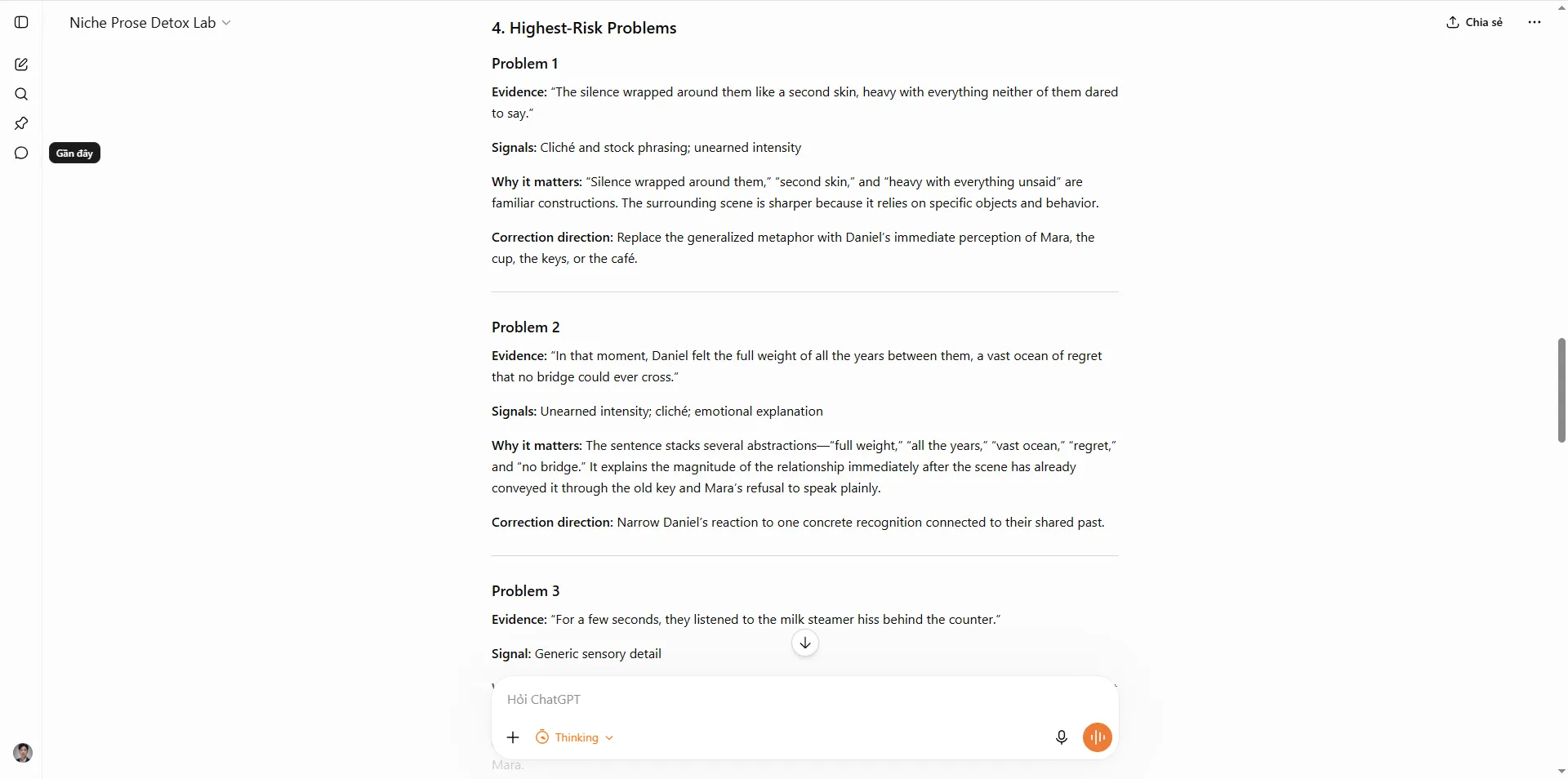
You already know the feeling. You just don’t know which sentences started it.
A beta - or your own reread after sleep - says “something feels off.” Not wrong. Not broken. Off. You open the scene and start cutting. An hour later the page is smoother… and more anonymous. Or worse: you deleted a thousand good words hunting three bad ones.
Once a reader suspects the prose, the sentences around it start getting judged differently.
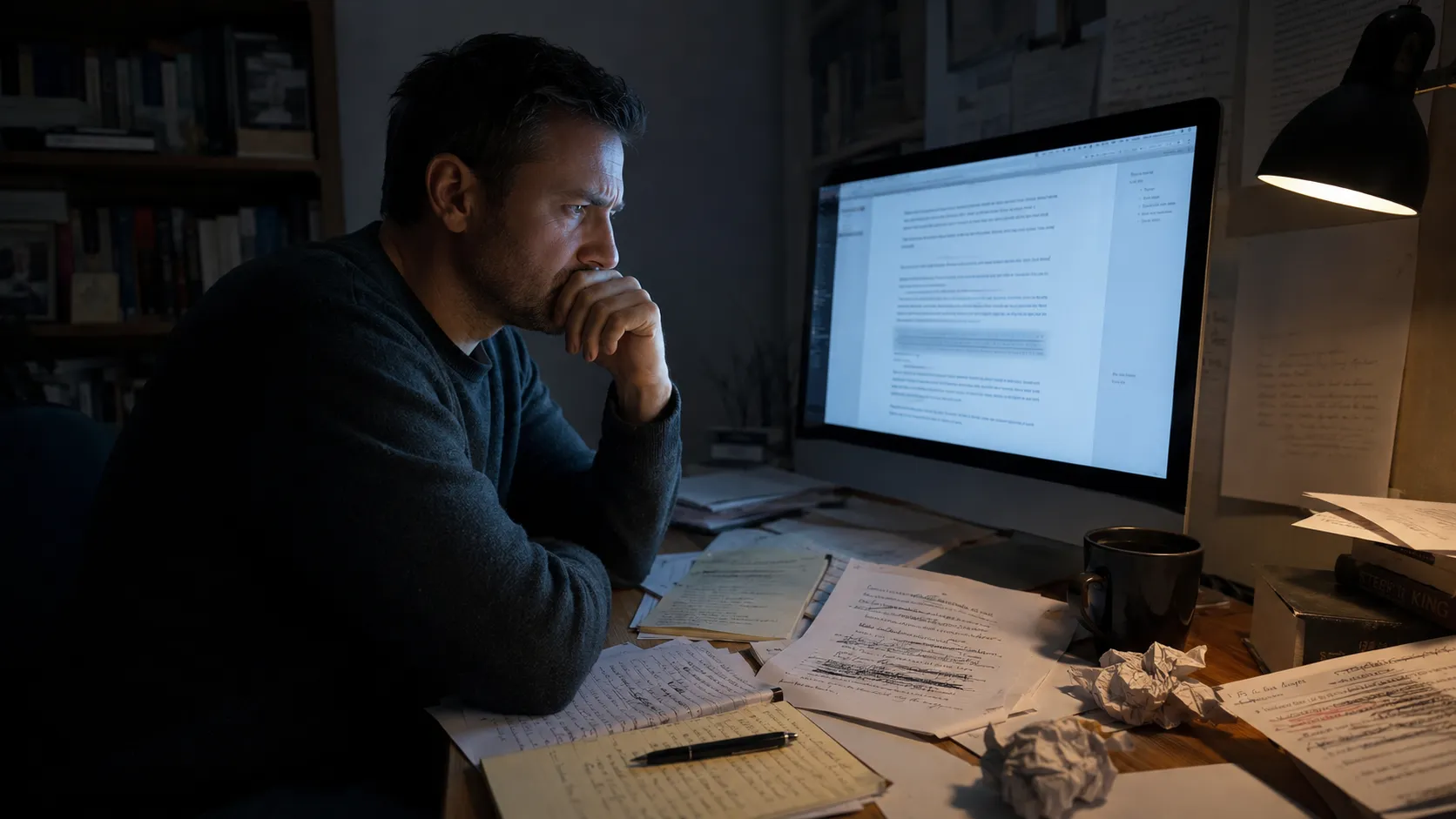
If any of these sound familiar:
- Every sentence is “correct,” but nothing feels alive.
- Another AI polish made it smoother - and more anonymous.
- You rewrite 1,500 words to fix three sentences.
- You no longer know which lines are still yours.
The cost isn’t only a lukewarm review later. It’s the writing day you burn over-editing the wrong places because nobody can show you the exact lines. You’re not missing “better prose.” You’re missing certainty about where to edit.
The enemy isn’t “AI writing.” It’s a Trust Leak - a few polished, empty sentences that make readers trust the page a little less.
Your whole manuscript may not sound like AI. It only takes a handful of hollow lines. Readers don’t need proof you used AI. They only need to feel that something belongs to no one.
Why I built this instead of another “make it sound human” prompt

Nhan Scope
Founder · Niche Prose Detox Lab
I kept watching the same failure: a writer pastes a strong scene into an AI writing assistant, asks it to “sound more human,” and gets smoother prose that no longer sounds like them. The plot survives. The voice doesn’t. And still - nobody can point to the three lines that started the distrust.
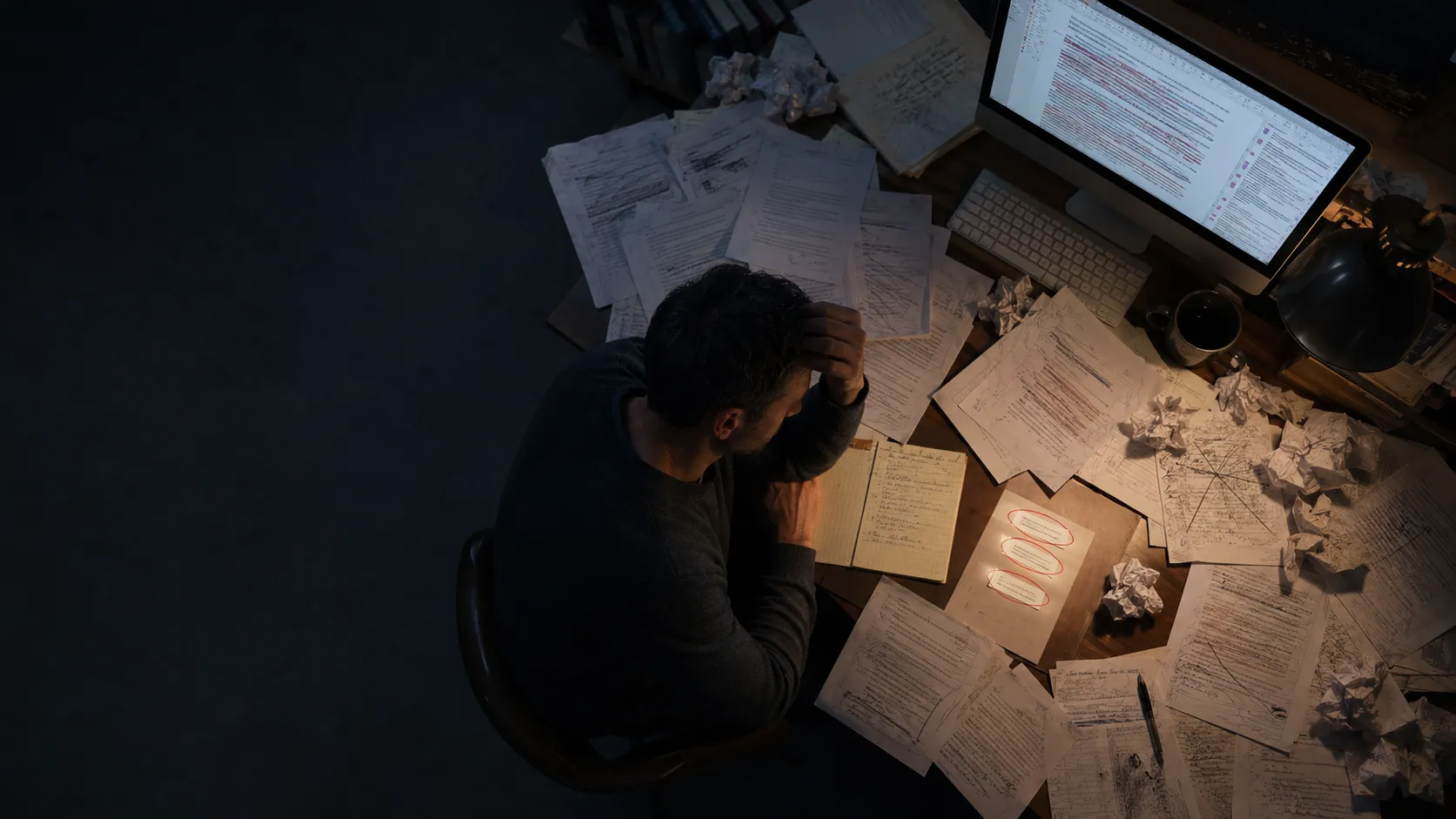
Free chat AI is excellent at rewriting. It is unreliable at spotting which lines leak trust. So I catalogued the recurring patterns that show up when “fine” prose still feels anonymous - then built Niche Prose Detox Lab so flags and reasons come first. Optional controlled rewrite second, only on lines you approve. Not an AI detector. Not a full-scene overwrite. A flag is not a verdict - including when you disagree with the Lab.
Now name the lines. Then decide.
Scan first. Rewrite second. The core mechanism is the Trust Leak hunt: flag the exact lines that make readers trust the page a little less. See why. Keep your voice. Optional controlled rewrite - only if you ask, only on lines you approve.
Supporting checks (not the product you’re buying): Voice Break - lines that stop sounding like your POV · Scene Mismatch - lines that break your named genre promise
1. Exact flags + reasons
Named signals on specific lines - so you see the Trust Leak, not a vague “sounds AI” judgment.
A flag is not a verdict. Deliberate style can look like a signal. You decide.
2. Controlled rewrite (optional)
Line-level alternatives that keep POV, beat, and intent. Accept, edit, or reject each one - never a blind full-scene overwrite.
3. Optional helpers
After the reasoning: quick density helpers (where clusters sit) and a rough scene-attention estimate if you want to dig deeper or move on.
Helpers - not the product’s core proof.
Generic “make it less AI”
- Often rewrites before reviewing the lines
- Changes the whole passage
- Smooths away your voice
- May rewrite without consistently isolating the line first
Niche Prose Detox Lab
- Finds Trust Leak lines first
- Explains why each flag matters
- Optional rewrite - line by line
- Fixed workflow you can repeat
What happens after you buy
You do not need a free afternoon to “learn the product.” Your first useful scan fits in about fifteen minutes.
-
Minute 1–3
Open the Quick-Start Guide and choose the scene you trust least.
-
Minute 4–6
Use the Scene Prep Checklist to add POV, subgenre, scene purpose, and essential context.
-
Minute 7–10
Paste the scene into Niche Prose Detox Lab and run the Trust Leak scan.
-
Minute 11–15
Review the exact flagged lines, read the reasons, and decide:
- Keep it
- Rewrite it yourself
- Request a controlled alternative
- Ignore the flag
By the end of the first session, you should know whether the problem is spread across the scene - or hiding in three sentences.
This is not just another prompt in a PDF
A prompt gives you an answer once. Niche Prose Detox Lab gives you a repeatable revision system: the Trust Leak scan, plus kit guides for prep, flag decoding, deliberate-style protection, and chapter continuity.
You are not buying one clever answer.
You are buying a process you can reuse every time a scene feels “off.”
What the Lab leaves alone
Fix less. Preserve more. The point isn’t to rewrite your scene. It’s to stop rewriting the parts that already work - so you don’t trade voice for smoothness.
- Strong lines that already sound like you
- Deliberate repetition
- Intentional narrator distance
- Genre-appropriate conventions
- Unusual phrasing that serves the character voice
- Lines you explicitly decide to keep
A flag is not a verdict. You keep, rewrite, or ignore - which is why this is safer than a prompt that rewrites the whole scene by default.
What a useful result should look like
The product earns trust by showing its work - reasoning before rewriting.
“This scene sounds 63% AI-generated.”
“Here is a rewritten version of your entire passage.”
A useful result looks like this- Flagged line
- “She somehow almost seemed to feel a little uncertain…”
- Signal
- Hedge inflation
- Why it matters
- Four softeners delay the threat and weaken the POV’s certainty.
- Your options
- Keep it · Cut two hedges · Rewrite the line · Reject the flag
Why re-reading - or a free “less AI” prompt - still leaves you guessing.
1. Re-reading the scene yourself
You wrote it. Your eye skips patterns a stranger catches in one pass - especially polished lines that feel “fine” because they’re familiar.
Why it fails: You’re checking for meaning. Readers are reacting to style.
2. Asking your AI writing assistant to “make it sound less AI”
The model often rewrites first and hopes. It can smooth the passage, blur your voice, and skip consistently isolating which sentence felt off.
Why it fails: Unstable. Rewrite-first. Hard to repeat the same standard.
“Couldn’t I just write a long prompt that checks seven things?”
You could try. The difference is a fixed review workflow vs. an improvised ask that changes every time.
| Free / custom prompt | Niche Prose Detox Lab |
|---|---|
| Output shifts with how you ask | Fixed Trust Leak workflow → optional rewrite |
| Often rewrites too early | Flag first; rewrite only lines you choose |
| Hard to repeat across a manuscript | Reusable process + kit guides |
Two genres. Same rule: you decide.
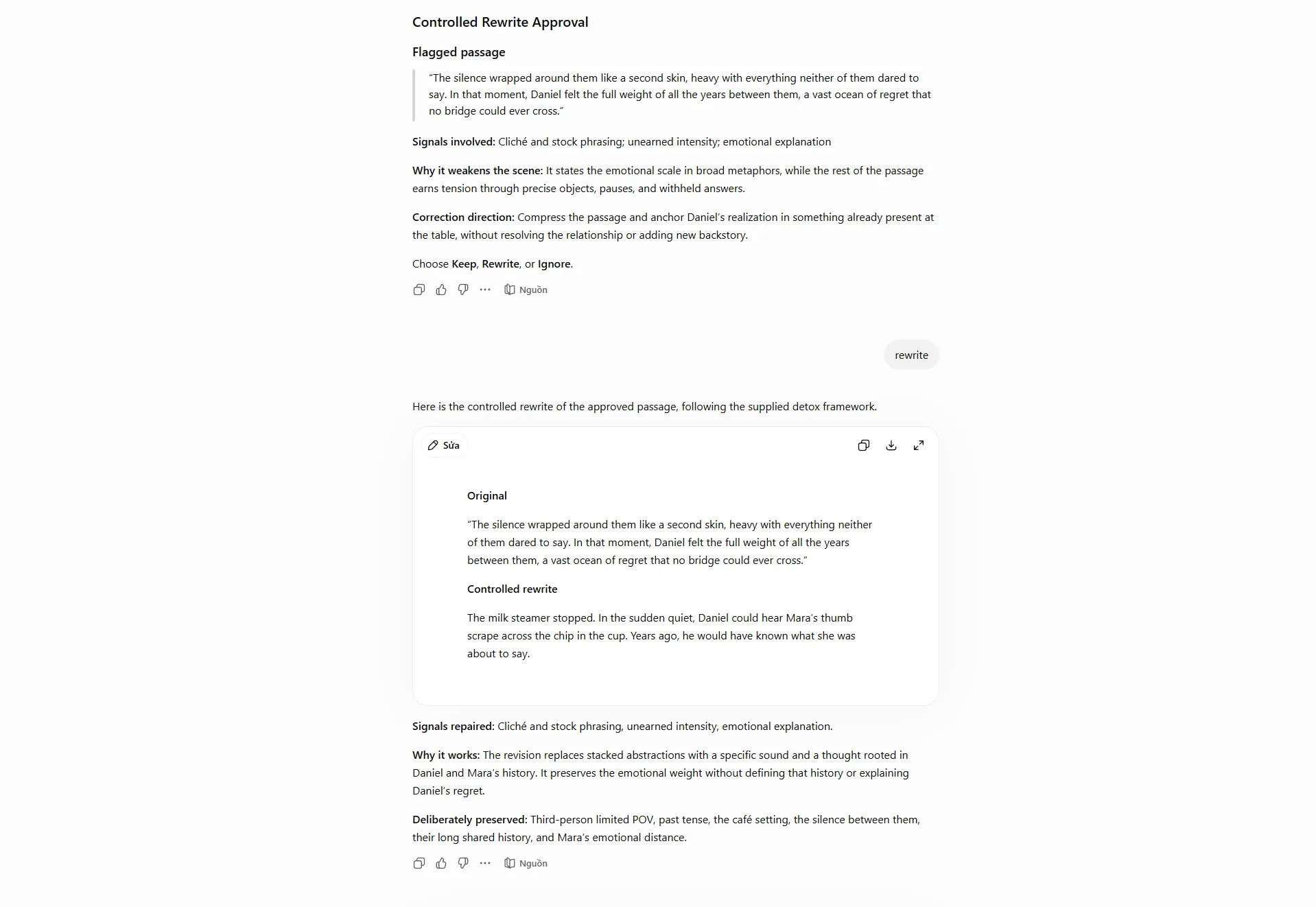
How the decision looks on the page - flag, reason, then a controlled rewrite of that line only.
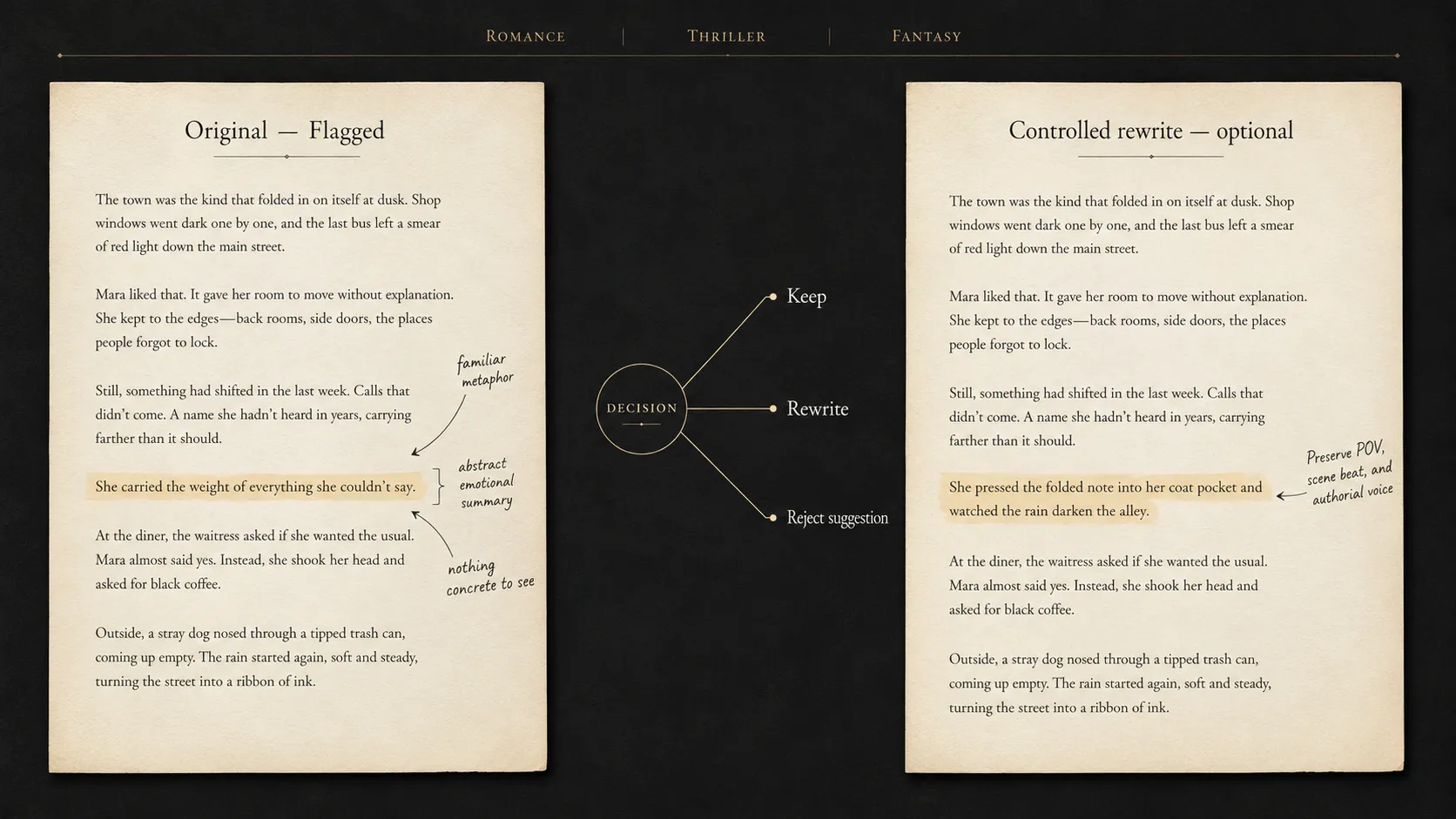
“The silence wrapped around her like a second skin, heavy with everything neither of them dared to say.”
Familiar metaphor + abstract emotional summary. Sounds meaningful - gives the reader nothing concrete to see or feel. That’s a Trust Leak.
“She counted three breaths before he looked up. Neither of them filled the quiet.”
“Mira understood that the council’s decision would reshape the balance of power across the northern holds, and that her silence now would be interpreted as consent.”
Reads clean - but drifts into explanatory narrator voice. “Understood that…” lectures the geopolitics instead of staying in Mira’s body.
“If she stayed quiet, the council would count her with them. Mira kept her mouth shut anyway.”
Watch a full scene: flag → reason → keep or rewrite.
- Exact Trust Leak lines with reasons
- At least one strong line left alone
- One rewrite accepted - one rejected on purpose
Everything included today
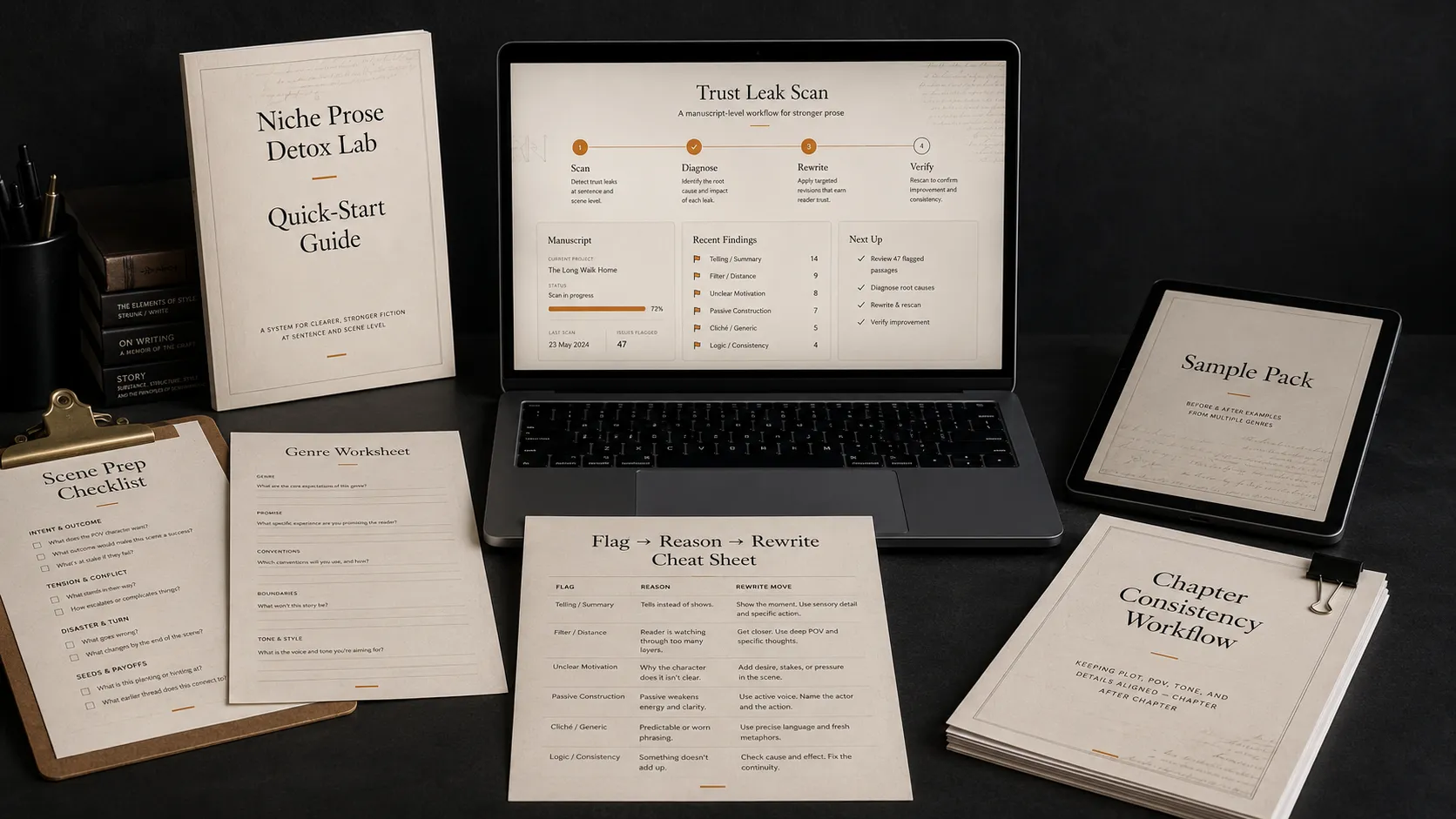
Paste one scene (~1,000–2,000 words). See Trust Leak flags and reasons. Optionally request controlled rewrites. You decide - with a full revision kit beside the Lab.
-
1 · Niche Prose Detox Lab
Paste one scene. Get exact flags with reasons.
The diagnostic engine
-
2 · Quick-Start Guide
Useful scan without learning prompt engineering
Run your first scene in minutes
-
3 · Scene Prep Checklist
What context to include before you paste
Get a cleaner first scan
-
4 · Seven-Signal Revision Cheat Sheet
Recognize the pattern, not just the label
Decode every flag
-
5 · Genre Contract Worksheet
Romance, thriller, or fantasy - by your subgenre
Tell the Lab what your genre must deliver
-
6 · Diagnostic Sample Pack
Flag → reason → keep / edit / reject examples
See the method applied
-
7 · What to Ignore Guide
When a signal is style - not a mistake
Protect your deliberate voice
-
8 · Continuity Protection + Offline Backup
Chapter workflow + PDF/TXT backup
Carry the workflow across a manuscript
One payment. No subscription. Instant access: Custom GPT + full revision kit (PDF and TXT).
Less than the cost of wasting another writing afternoon on the wrong 1,500 words.
Start with one scene - not eight PDFs
You do not begin by reading the whole kit. You begin by pasting the scene that feels wrong.
- 1Open the Quick-Start Guide
- 2Use the Scene Prep Checklist
- 3Run the Lab
- 4Open a guide only when a decision needs it (cheat sheet, What to Ignore, samples)
Save Genre Contract and Continuity Protection for later passes.
No course. No modules. No homework.
Diagnose one real scene today.
This is probably not for you if…
- You want a button that rewrites your entire manuscript automatically.
- You want proof that a passage was written by AI.
- You want every flag to be objectively correct - or you don’t want final editorial decisions.
- You need developmental editing of plot, character arc, or story structure.
Niche Prose Detox Lab does one narrower job: find the lines that may make an otherwise strong scene feel generic, hollow, or unlike your voice.
FAQ
Is this an AI detector?
No. It finds lines that may read generic or hollow - Trust Leaks - not proof of how a sentence was produced.
Does it rewrite my whole scene?
No. Optional controlled rewrite of flagged lines only. You approve every change.
Can it flag the wrong lines?
Yes. A flag is not a verdict. Intentional style can look like a signal. Keep, change, or ignore.
Do I need ChatGPT Plus?
No. Free ChatGPT works. Paid plan optional for higher limits. Not included in purchase.
Hand-written only / AI polish only - still useful?
Yes if you’re hunting generic, hollow, or voice-drift lines. The niche is AI-assisted fiction; the Lab flags style patterns, not authorship.
Why both PDF and TXT?
PDF for reading. TXT for copying and searching beside your manuscript. You’re not locked into one interface.
What if the link breaks / it doesn’t help?
Email nhanscope@gmail.com for the current link, or for a full refund under the One-Scene Test within 30 days.
The One-Scene Test
Don’t decide if the Lab works. Give it one scene and make it prove itself.
Pick the scene a beta called “off,” the one that got too smooth after AI polish, or the one that no longer sounds like you. Run the workflow once. If it cannot point to anything useful - or it’s simply not for you - email nhanscope@gmail.com within 30 days for a full refund.
You keep the risk at zero.
The scene gives the verdict.
Your next beta may only say “something’s off.” Don’t burn another scene guessing which three sentences started it.
Find those sentences. Keep the story yours.
Niche Prose Detox Lab · $16.95 one-time · less than one wasted rewrite afternoon
Run the One-Scene Test - $16.95P.S. - Before your next beta pass, run one real scene. If the flags and reasons don’t reveal anything useful, email nhanscope@gmail.com within 30 days for a full refund - no questions asked. $16.95 vs. another afternoon rewriting the wrong lines.