Book 01Medium
SettingLibrary
MechanicLocked-room deduction
TwistCrown hidden in plain sight
Titles, suspects, clue logic, answer keys, and KDP listing angles — ready to refine — from one guided session.
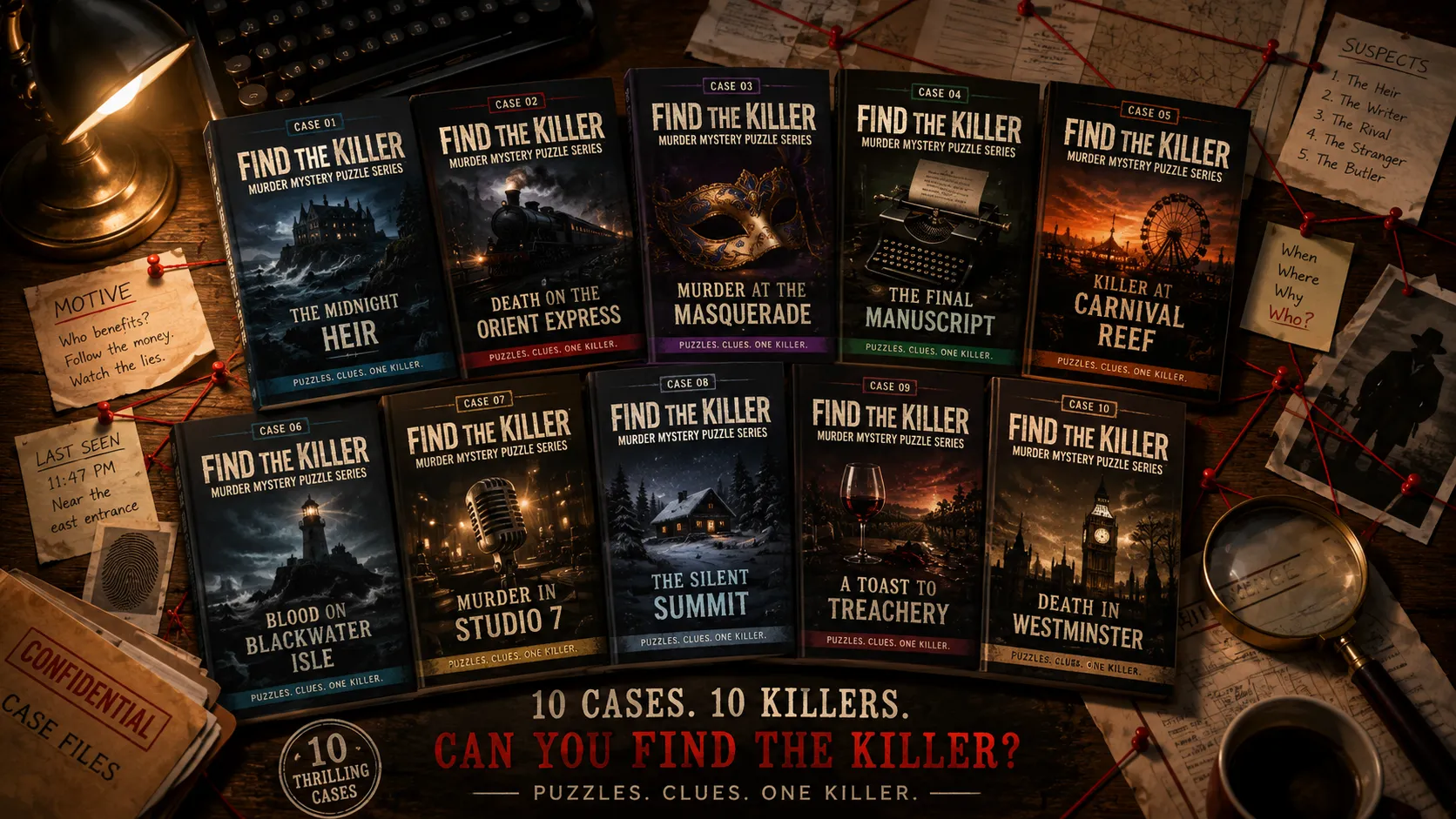
One-time price · $16.95
Yes – Give Me the 10-Book Series Blueprint for $16.95One-time payment · Instant access · 30-day refund
Multilingual support available — start with your language.
No design skill required. No writing background required. Works even if you've never plotted a mystery in your life.
Before you read another word, see exactly how Mystery Case Puzzle Series Factory GPT walks you through planning, puzzle logic, and marketplace packaging — from a single theme to a complete series blueprint.
Click to play — video loads only when you choose to watch.
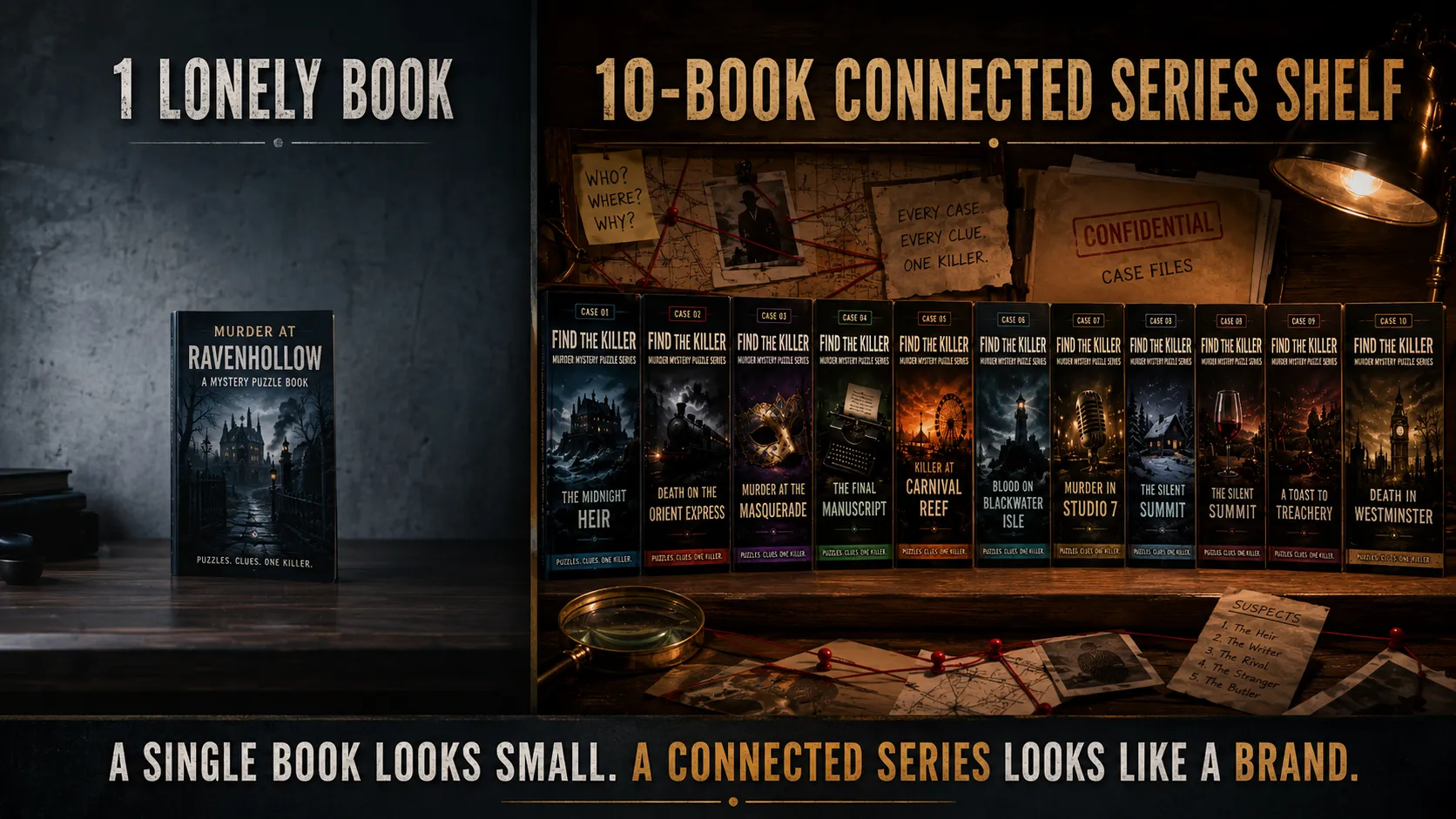
You publish a mystery puzzle book. It sells eleven copies. Then it sinks. No series. No reason for a reader to come back. Just another lonely listing competing with every other one-off on the shelf.
That isn't bad luck. It's what happens when you sell single books in a market that rewards series.
"You are not in the puzzle book business. You are in the series business — and nobody told you."
Readers fall in love with a format they can return to — same world, same promise, book after book. The publishers who build lasting catalogs stop asking for “one more idea” and start building a ten-book system. That's what the three engines below are built to hand you — in one sitting.
Ask any AI chatbot for "a whodunit puzzle book idea" and it will hand you something in four seconds. That's not the problem. The problem shows up the moment you try to do it ten times in a row, on purpose, so it holds together as a brand.
Suddenly you're stuck juggling:
None of this is your fault. Generic AI tools were built to answer one question at a time. They were never built to hold an entire ten-book publishing roadmap in their head — the branding, the clue logic, the suspects, the keywords, the copy — all pulling in the same direction, all at once.
So you either burn a weekend duct-taping ten separate ideas into something that resembles a series… or you quietly give up and publish "just one more" standalone book, the same way you did last time. And the time before that.
This wasn't built by asking "how do I generate one puzzle book idea faster." That question has been answered a hundred times already, by a hundred generic prompt packs that all produce the same shallow output: a title, a vague setup, maybe a suspect list with no real logic behind it.
The actual question was harder: how do you get a large language model to hold an entire publishing roadmap in its head at once — the brand angle, the escalating difficulty curve, the suspect logic, the clue fairness, the KDP keyword brainstorming ideas — without it drifting, repeating itself, or quietly falling apart by book six?
That meant treating this less like a chatbot prompt and more like an actual production pipeline — one guided conversation with three built-in phases that run in order: plan the series first, build the puzzle logic second, package it for the marketplace third. Each phase has one job. None of them try to do everything at once, which is exactly where generic single-prompt tools fall apart.
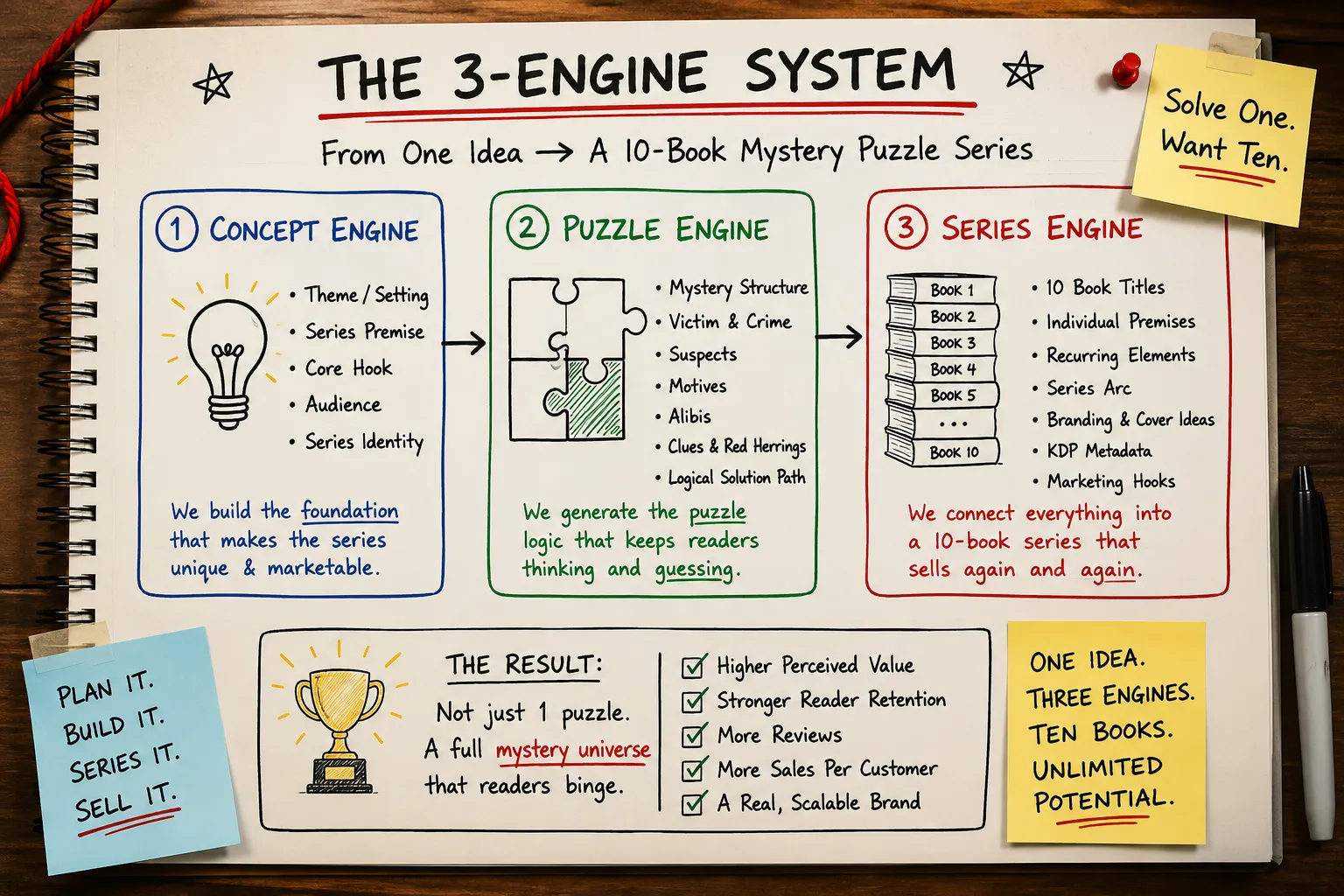
The result is a tool that doesn't just answer a question. It walks an entire investigation with you, from the first theme you type in, to the last answer key on book ten.
This is exactly why many publishers with the most cohesive series catalogs on KDP rarely look like they got there by accident. They simply stopped publishing single books years ago. They publish systems. Series. Formats readers can collect.
The only reason more people don't do this already is because building a real series — one with a consistent brand angle, escalating difficulty, distinct-but-related titles, and clue logic that actually holds up — is genuinely hard to do by hand. It takes a working knowledge of mystery structure, puzzle design, and Amazon publishing all at once.
Which is exactly the gap this tool was built to close.
One custom GPT. One conversation. Three engines — and one finished 10-book series blueprint at the end.
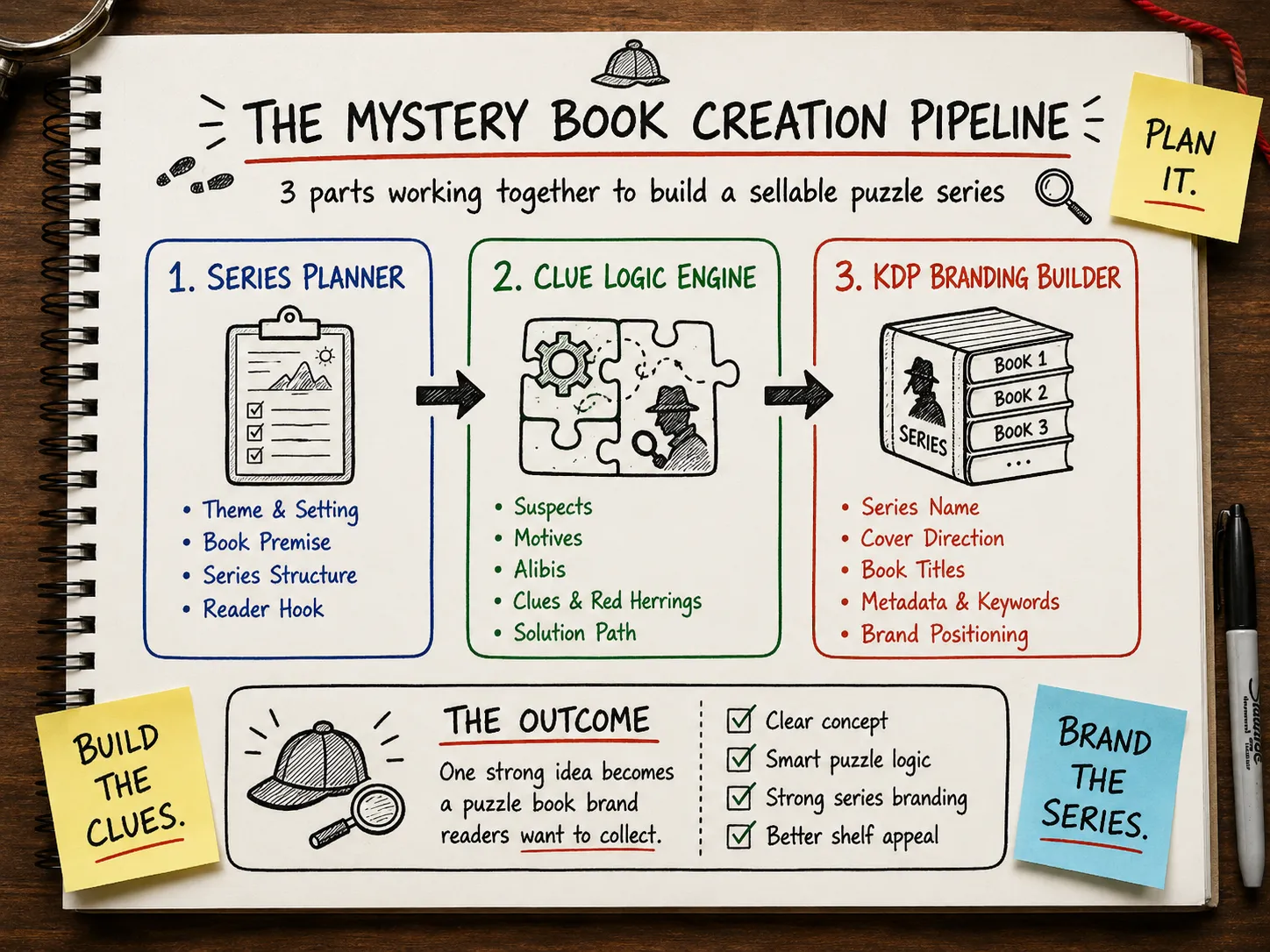
By hand this often takes 40+ hours across multiple weekends. This GPT is built to compress that into one guided session.
Sample output from the theme "royal mansion whodunit" — one session, mapped and connected, ready to build.
Every book gets its own premise, suspects, clues and solution path — but they all pull in the same direction, because a human being didn't have to hold ten storylines in their head at once. The system did.
This isn't a "prompt pack." It's a working custom GPT that walks the whole planning process with you and hands over every piece of a real series blueprint. Nothing on this list is a throwaway line item — each piece exists because skipping it is exactly where most self-built puzzle series quietly fall apart:
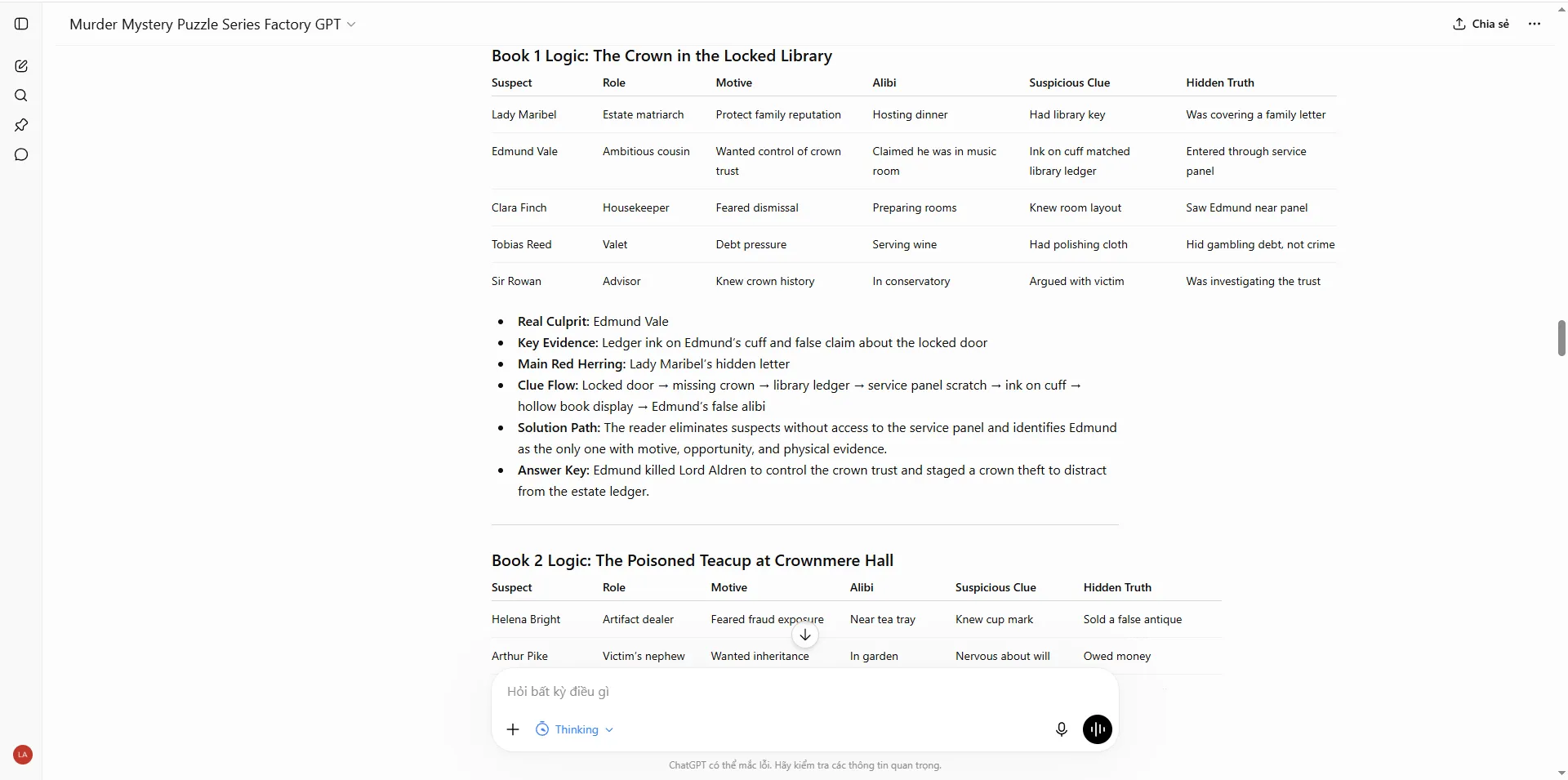
Notice what's missing from that list: guesswork. You're not left holding a title and a vague "figure out the rest yourself." Every deliverable connects to the next one — the suspect table feeds the clue flow, the clue flow feeds the solution path, the solution path feeds the answer key. By the time you reach the listing assets, the system already knows exactly what story it's selling, because it built that story from the ground up, in front of you.
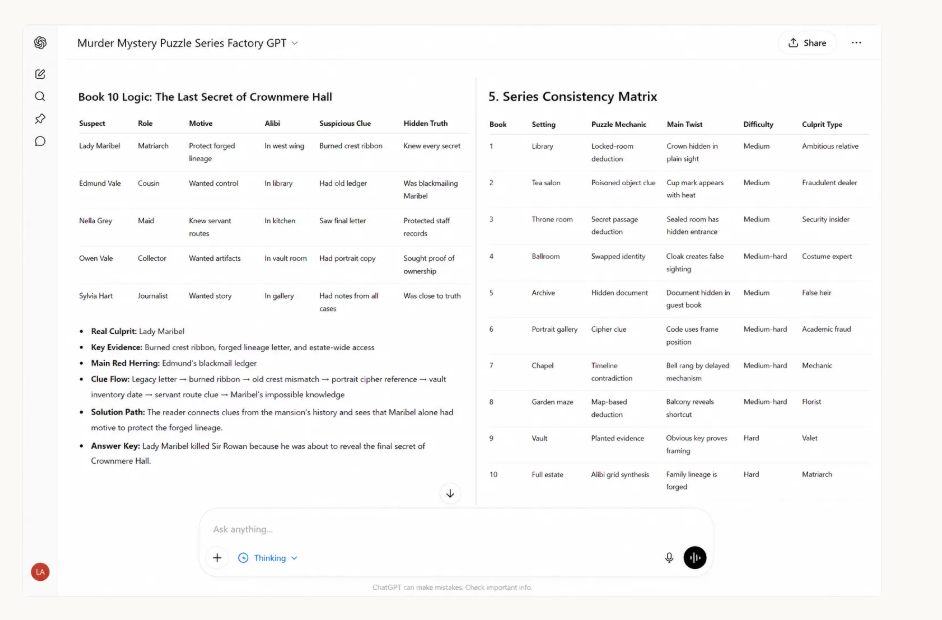
We typed "royal mansion whodunit" into the GPT and let it run. No editing. No cherry-picking. Open any exhibit below:
Every book gets its own setting and puzzle mechanic. Difficulty ramps from medium to hard. No two books repeat the same trick:
| Book | Setting | Puzzle Mechanic | Main Twist | Difficulty |
|---|---|---|---|---|
| 01 | Library | Locked-room deduction | Crown hidden in plain sight | Medium |
| 02 | Tea salon | Suspicious object clue | Cup mark appears with heat | Medium |
| 03 | Throne room | Secret passage deduction | Sealed room has hidden entrance | Medium |
| 04 | Ballroom | Swapped identity | Cloak creates false sighting | Medium-hard |
| 05 | Archive | Hidden document | Document hidden in guest book | Medium |
| 06 | Portrait gallery | Cipher clue | Code uses frame position | Medium-hard |
| 07 | Chapel | Timeline contradiction | Bell rang by delayed mechanism | Medium-hard |
| 08 | Garden maze | Map-based deduction | Balcony reveals shortcut | Medium-hard |
| 09 | Vault | Planted evidence | Obvious key proves framing | Hard |
| 10 | Full estate | Alibi grid synthesis | Family lineage is forged | Hard |
"Specificity is the ultimate proof. Generic tools give you ideas. This gives you a case file."

I once spent six months building a puzzle book series by hand — and learned the hard way how much time a disconnected catalog wastes. I built this tool so you don't have to take that detour.
One-time price · $16.95
One-time payment · Instant access · 30-day refund
Multilingual support available — start with your language.
A haunted hotel. A small coastal town. A traveling circus. Anything you're drawn to. That's the only input the system needs to get started.
One guided conversation walks you through planning, clue logic, and marketplace packaging — keywords, series-level back-cover draft, and per-book description angles included. Built-in follow-up prompts at the end let you expand, refine, or start fresh.
Ten titles. Ten premises. Ten suspect tables. Ten clue flows. Ten answer keys. One cohesive brand — plus listing assets and an interior page plan — ready to hand to a designer or start building yourself.
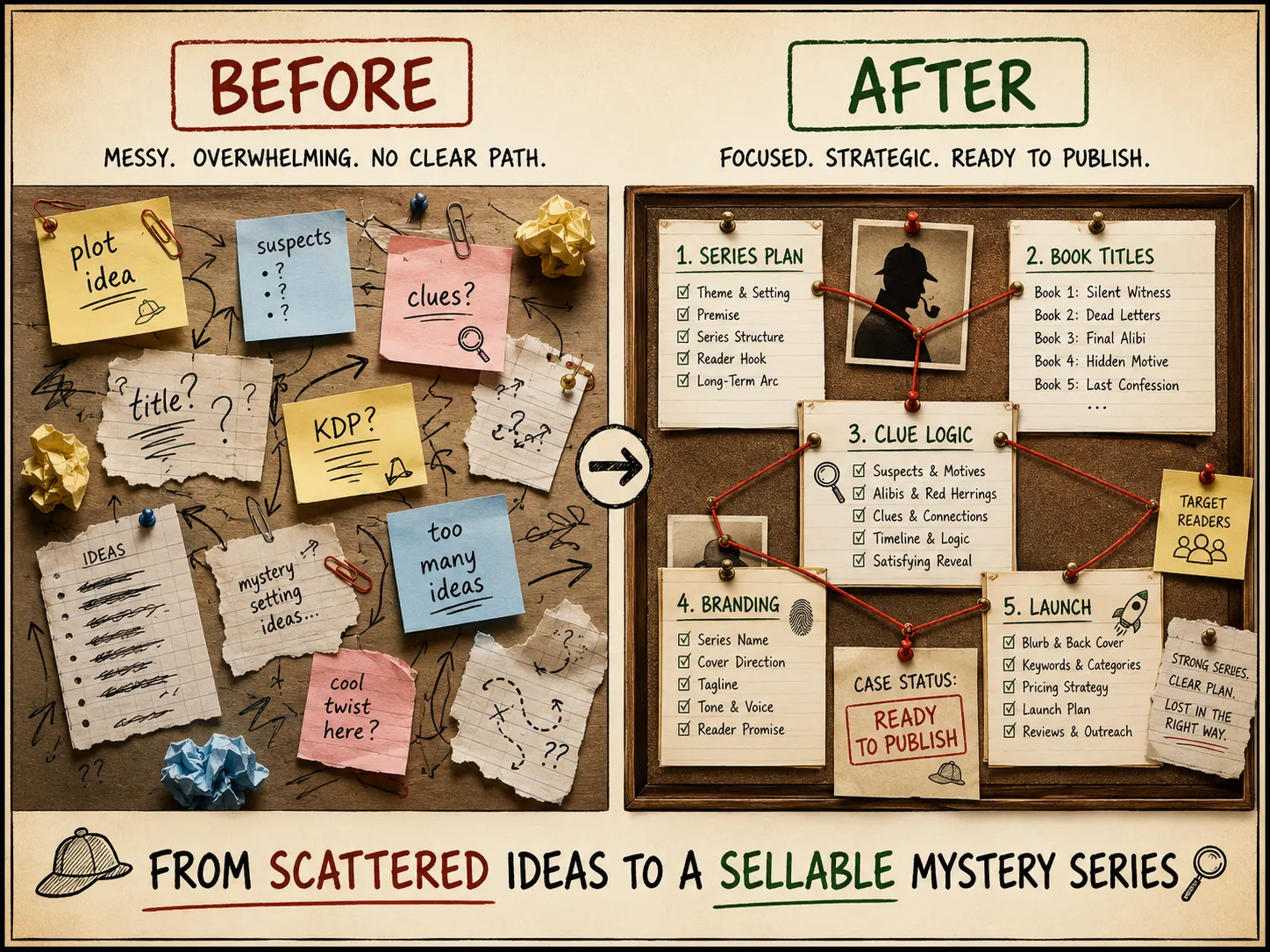
Everything above — the full series blueprint, clue logic, book listing assets, interior page plan, and built-in follow-up prompts — in one custom GPT you can reuse across multiple series, subject to platform access and usage limits.
One-time payment. No subscription. Yours to reuse for every future series.
Skip 40+ hours of manual planning. Building a coherent series by hand usually burns multiple weekends — titles, suspects, clue fairness, listing copy — before you even format a page.
Or hire someone to outline a series and spend hundreds. Here you get the full planning blueprint for $16.95, one time.
Instant access · One-time $16.95 · 30-day refund
Multilingual support available — start with your language.
Protected by a 30-day refund policy. Questions? nhanscope@gmail.com
Use it for a full month. If you're not happy for any reason, just email nhanscope@gmail.com. We'll refund 100% of your purchase — no long questionnaire, no complicated process.
No. The Clue Logic Engine exists specifically because most sellers don't know how to structure a fair "whodunit" by hand. You bring the theme; the system brings the structure.
You're still in. Multilingual support available — start with your language. Open the GPT, type in the language you actually think in, and build the full series blueprint from there. No need to translate your ideas first.
This is a planning and content blueprint — not a finished, upload-ready book file. You still refine the material, write/format the final pages, and check uniqueness yourself before publishing. The GPT gives you structure and ideas; editorial judgment and KDP compliance remain your responsibility. Amazon's policies evolve — always review the platform guidelines for AI-assisted content before you upload.
Amazon requires you to disclose AI-assisted content where applicable and to own the quality of what you publish. Using AI for outlines and planning is common — but you must review, edit, and finalize the work. This tool does not "auto-publish" anything for you, and it does not guarantee policy compliance or approval.
No — this delivers the full content and branding blueprint: titles, premises, suspects, clues, answer keys, keyword brainstorming ideas, a series-level back-cover draft, and per-book KDP description angles. You (or a designer) still build the physical book layout from that blueprint.
Yes. It's a one-time purchase — you can reuse it for multiple themes and series, subject to platform limits.
You can absolutely stop at one. But most sellers find that once they see how easily the other nine come together, they build out the full series anyway — that's the entire point of the system.
No. It's a single $16.95 payment for ongoing access to the custom GPT and its prompts — no subscription required.
You're covered by the 30-day refund policy above. Email nhanscope@gmail.com within 30 days — we'll refund 100% of your purchase, no long questionnaire.
No setup knowledge required. You get access to the ready-made custom GPT itself, plus beginner usage prompts that tell you exactly what to type in your very first message.
That's precisely what the built-in series structure prevents. Each book gets a distinct premise, setting, and puzzle mechanic inside the shared theme — and the follow-up prompts let you ramp difficulty or expand any single book without starting over.
Not automatically. You get one series-level back-cover copy draft, a short Amazon-style series description, and a per-book KDP description angle for each title — selling hooks you refine into full listings. The built-in follow-up prompts include "Create KDP descriptions for all 10 books" if you want to go further.
No — and we won't pretend otherwise. The GPT outputs keyword brainstorming ideas clearly labeled as starting points, not guaranteed marketplace data. You still review, test, and customize them for your niche.
Yes. The engines work from whatever theme and tone you provide — the same underlying structure adapts to classic detective puzzles, cozy logic mysteries, or lighter, family-friendly "find the culprit" formats.
Picture the version of this a month from now where you never opened this case file. You're still holding the same one idea. Still planning to "get to the rest of the series eventually." Still publishing single, disconnected books that ask a reader to take a chance on you all over again with every listing.
Now picture tomorrow morning: you open your laptop and already have ten titles, ten premises, and ten complete clue sets in hand. You hand them to a designer — or build the books yourself — instead of staying up until 2am trying to invent book three from scratch.
This closes that gap for $16.95.
One-time price · $16.95
Yes – Give Me the 10-Book Series Blueprint for $16.95One-time payment · Instant access · 30-day refund
Multilingual support available — start with your language.
P.S. — Many publishers who build lasting KDP catalogs are almost never the ones with the single "best" book. They're the ones who published the most cohesive series first. This is designed to help you get there faster — starting this week. Results vary. Multilingual support available — start with your language.
P.P.S. — Try it for 30 days. If you're not happy for any reason, email nhanscope@gmail.com for a full refund — no long questionnaire.