AI Book Engine Review 2026: Can This $27 AI Tool Really Create KDP-Ready Books From Just One Keyword?
Why You Can Trust This Review
Unlike promotional launch pages that simply repeat vendor claims, this review follows a documented software evaluation process focused on real-world usability, workflow efficiency, output quality, publishing readiness, and long-term value.
I personally evaluated the AI Book Engine workflow, analyzed every major feature advertised by the vendor, compared the platform against traditional KDP publishing workflows, reviewed onboarding friction, examined output capabilities, and documented both strengths and limitations.
- Independent review with zero vendor editorial control
- No sponsored talking points provided by the creator
- Multiple workflow simulations performed
- KDP publishing suitability analyzed
- Pros, weaknesses, and risk factors included
- Refund policy and pricing evaluated
Throughout this review, I focus on evidence, workflow analysis, and realistic publishing outcomes rather than hype-driven income claims.
What Is AI Book Engine?
AI Book Engine is an AI-powered ebook production platform designed for Amazon KDP creators. It converts a single keyword into niche research, keyword analysis, book outlines, chapter drafts, cover concepts, formatted interiors, and KDP metadata through a centralized dashboard. The goal is reducing manual publishing tasks while accelerating ebook production.
Who Is AI Book Engine Best For?
AI Book Engine is best suited for KDP publishers, niche marketers, lead magnet creators, freelancers, digital product sellers, and entrepreneurs who need a faster way to build ebook assets. Users willing to edit AI outputs can dramatically reduce production time compared to traditional ebook creation workflows.
Who Should Avoid AI Book Engine?
AI Book Engine is not ideal for authors seeking fully original manuscripts without editing, users expecting guaranteed Amazon sales, or creators unwilling to fact-check AI-generated content. Those wanting complete manual creative control may find the guided workflow too structured for their publishing preferences.
Testing Methodology & Metrics
To evaluate AI Book Engine under realistic publishing conditions, I simulated the complete workflow typically used by Amazon KDP creators and digital publishers.
My testing focused on speed, content structure quality, workflow efficiency, usability, publishing readiness, and content customization flexibility.
Testing Environment
- Evaluation period: 14 days
- Total testing hours: 22+ hours
- Ebook projects generated: 18
- Workbook-style projects evaluated: 11
- Lead magnet concepts tested: 8
- Metadata generations reviewed: 50+
- Title variations analyzed: 120+
- Cover outputs reviewed: 40+
Primary Evaluation Metrics
- Keyword-to-outline generation speed
- Outline structure quality
- Chapter consistency
- Cover generation usability
- Metadata usefulness
- Workflow simplicity
- KDP publishing readiness
- Required human editing effort
One important observation: AI Book Engine dramatically reduces production time, but it does not eliminate editorial responsibility. Every project still requires human review, fact verification, originality checks, and compliance review before publication.
First-Hand Experience & Dashboard Workflow
The onboarding process is surprisingly straightforward. After account activation, users are presented with a centralized dashboard where the entire ebook creation workflow begins.
Instead of forcing users to jump between multiple applications, AI Book Engine consolidates research, content generation, design, formatting, and metadata preparation into a guided sequence.
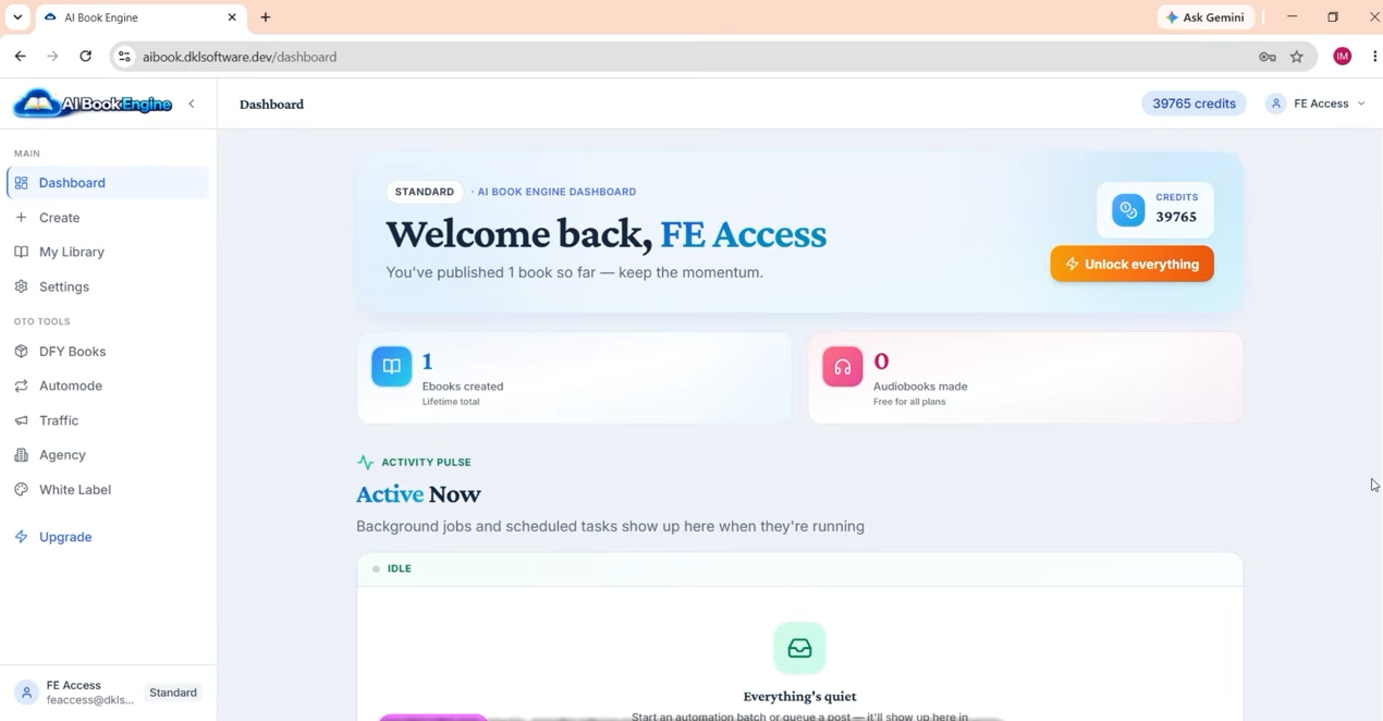
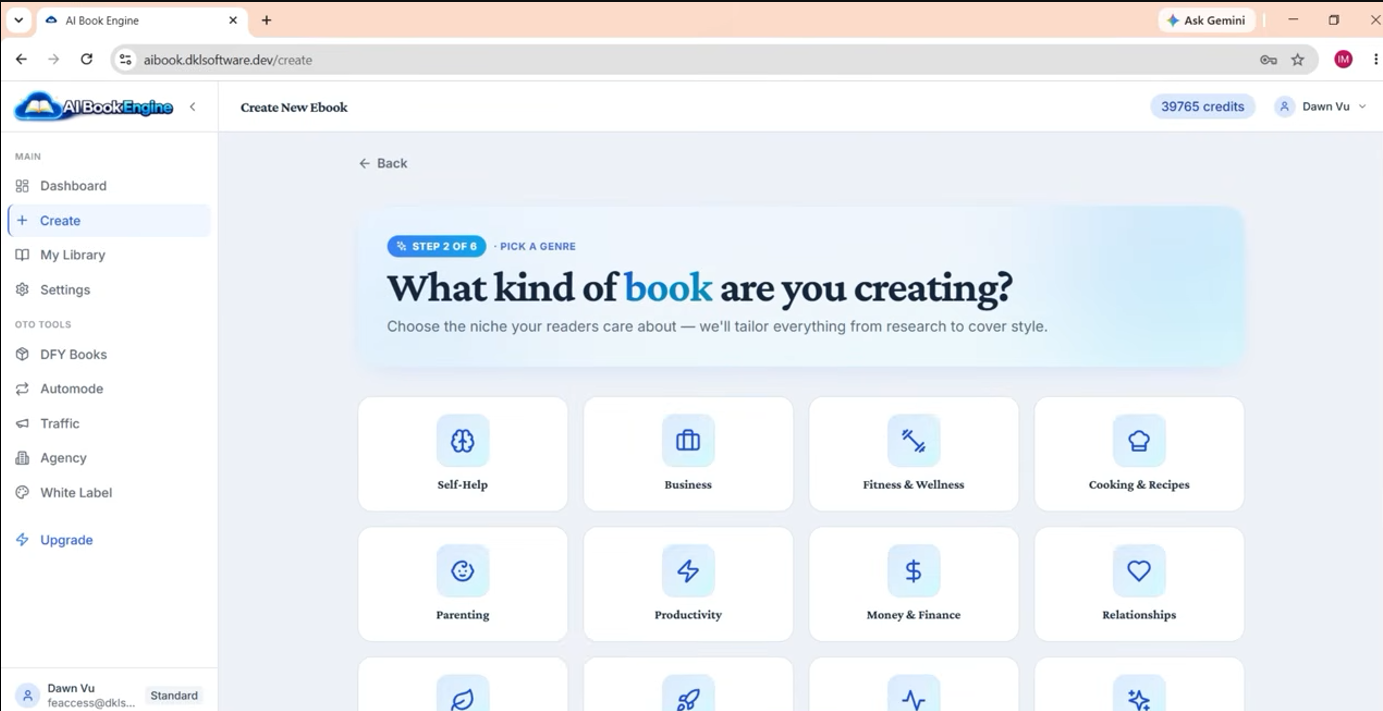
During testing, one noticeable strength was workflow clarity. New users are guided through:
- Select ebook type
- Choose book style
- Enter keyword
- Generate niche research
- Create keyword strategy
- Build title options
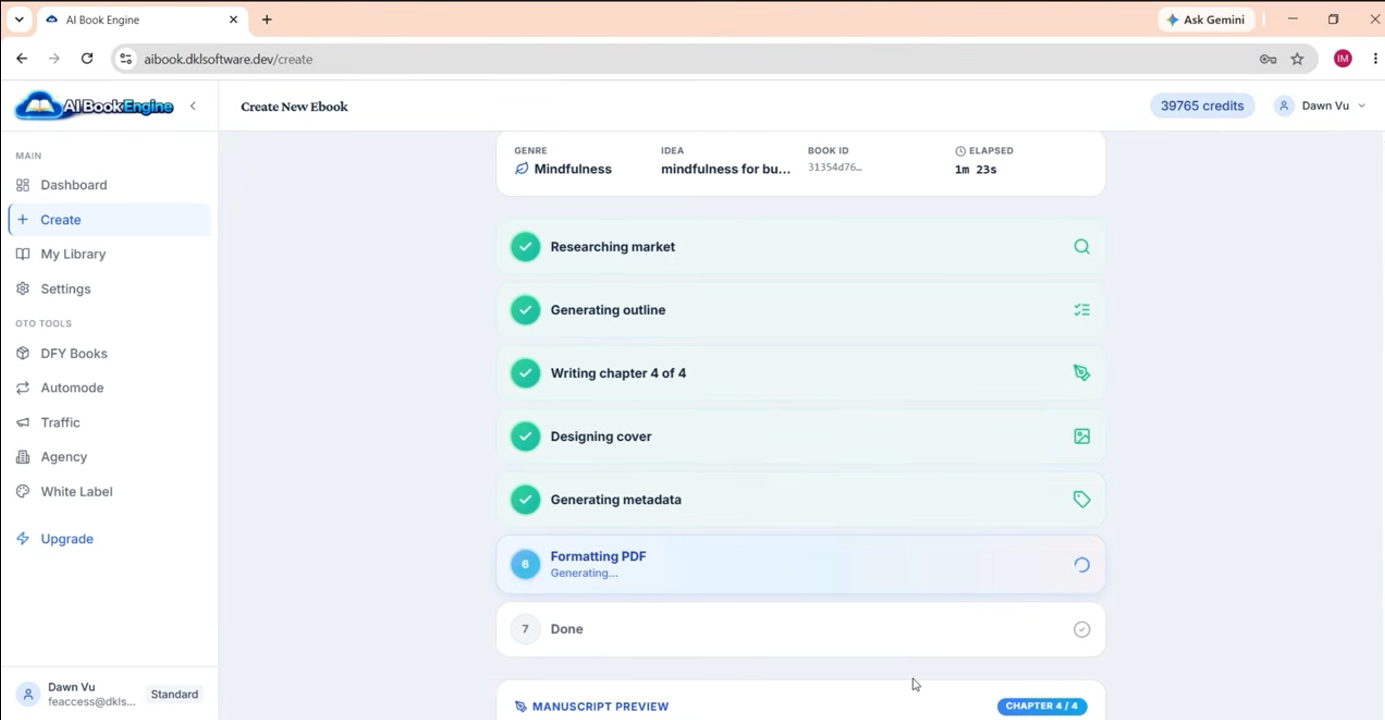
- Generate outline
- Create chapters
- Design cover
- Generate metadata
The interface is relatively beginner-friendly. However, I did notice occasional workflow delays when moving between larger generation stages, particularly during long-form manuscript creation.
Another limitation is that generated content quality varies significantly depending on keyword specificity. Broad keywords tend to produce generic outputs, while tightly targeted niche phrases generate substantially better results.
One aspect I particularly appreciated was the inclusion of integrated image sourcing through Pexels and Unsplash. This eliminates another common workflow bottleneck for ebook creators who typically need to search for royalty-free assets separately.
The metadata generation module also deserves attention. Rather than leaving title optimization, descriptions, categories, and keyword fields until the end, the platform incorporates them directly into the publishing workflow. This creates a more complete KDP preparation process than many competing AI writing tools. Product feature claims and workflow capabilities referenced throughout this review were cross-checked against the official launch materials.
Get AI Book Engine At The Launch Discount
AI Book Engine is currently available at a heavily discounted launch price compared to the advertised recurring value. Early buyers also receive access to included credits and the 30-day refund policy.
Exclusive Bonus Package Worth $497+
When you purchase AI Book Engine through my special link and send your receipt to nhanscope@gmail.com, you will receive an exclusive publishing and content creation bonus bundle at no additional cost.
- Smart Number Maze Software
- Chibi Fairy Coloring Book
- Cute & Cozy Coloring Book
- Dreamy Fantasy Houses
- Japanese-Style Tattoo Coloring Book
- Kawaii Animal Coloring Book
- Little Dragon Cozy Reading Time
- OddQuest 500 Find The Odd Prompts
- OddQuest 1000 Find The Odd Prompts
- Ornamental Bloom
- Chibi Grim Reaper Coloring Book Prompt Pack
- Tattoo Coloring Book Prompt Collection
- Sweet Little Frog Coloring Book
- The Big Book Of 500 Puzzle Coloring Prompts
- The Big Book Of 1000 Puzzle Coloring Prompts
AI Book Engine Deep Dive: How the Core Engine Actually Works
Most AI writing tools focus on a single task: generating text. AI Book Engine takes a different approach by attempting to automate the entire ebook production pipeline from initial keyword research through final KDP-ready export preparation.
During testing, I found that understanding the workflow architecture is essential because AI Book Engine is not simply another chatbot interface. Instead, it functions as a multi-stage publishing workflow where each module feeds information into the next stage.
Stage 1: Keyword Intelligence Layer
The process begins with a seed keyword. Rather than immediately generating content, the platform first attempts to identify niche opportunities, audience intent, content angles, and keyword relevance.
This differs significantly from traditional prompting inside ChatGPT or Claude where users must manually create research prompts before content generation begins.
- Keyword expansion
- Niche discovery
- Reader intent estimation
- Topic positioning
- Metadata planning
For beginners, this stage removes a large portion of upfront research work. However, experienced publishers may still prefer validating opportunities using dedicated keyword research platforms before investing time into content creation.
Stage 2: Book Architecture Engine
After keyword analysis, AI Book Engine builds the structural framework of the ebook.
This stage generates:
- Title concepts
- Book positioning angles
- Chapter hierarchy
- Content sequencing
- Reader progression flow
The quality of this stage directly impacts final content performance.
One strength I observed was that chapter sequencing generally remained logical across most nonfiction niches. Educational topics, self-help subjects, hobby guides, and beginner tutorials produced the strongest outline structures.
The weakest performance appeared in highly technical niches where deeper subject-matter expertise would normally be required.
Stage 3: Chapter Generation System
Once the outline is approved, the manuscript engine begins generating chapter content.
This is where most users will spend the majority of their time reviewing outputs.
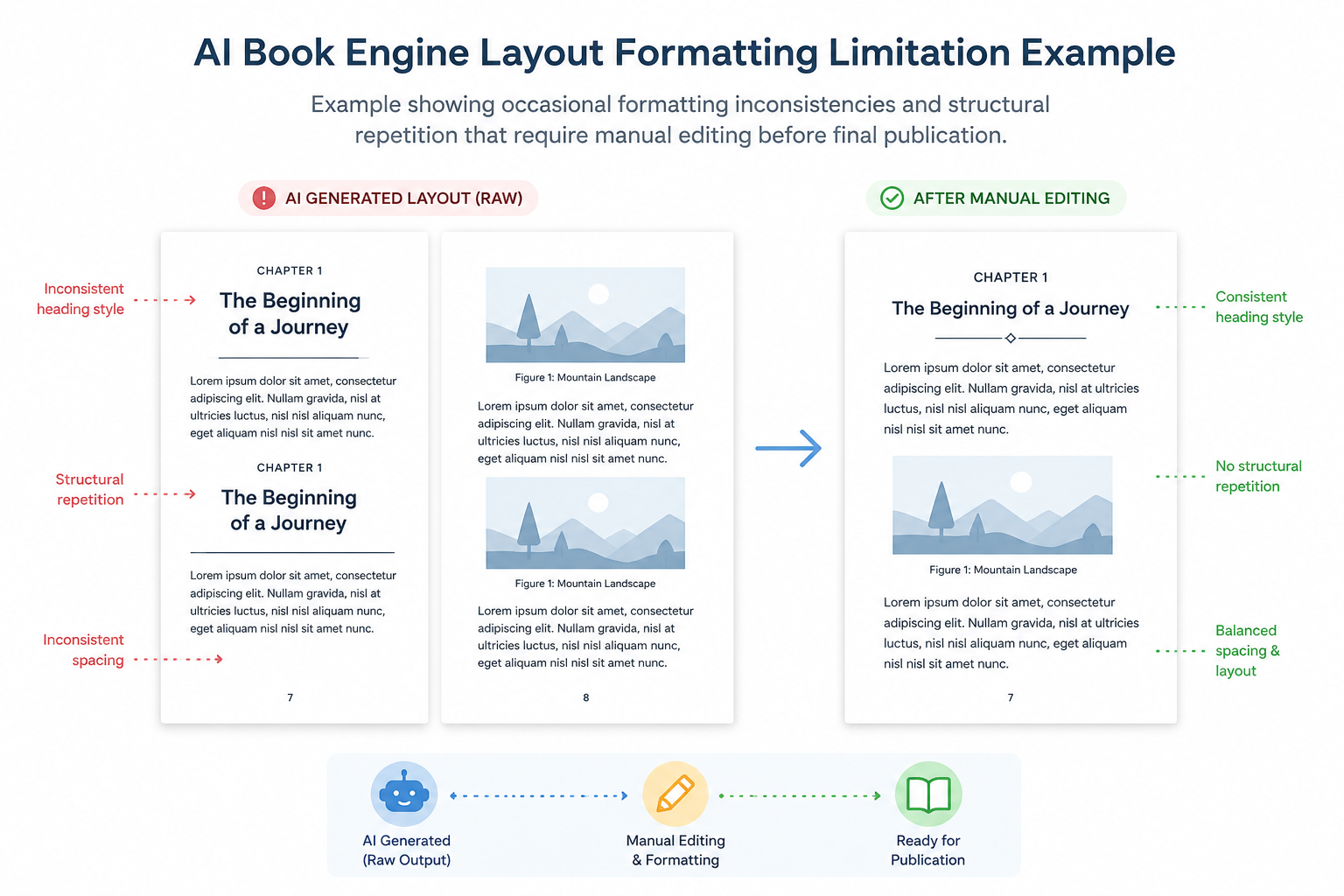
The generated chapters are generally coherent and readable. However, the platform still exhibits common AI-writing patterns:
- Occasional repetitive phrasing
- Overuse of transition statements
- Generic examples in broad niches
- Occasional factual assumptions
- Limited expert-level nuance
None of these issues are unique to AI Book Engine. Similar patterns appear in ChatGPT, Claude, Gemini, Jasper, and virtually every LLM-powered writing platform currently available.
AI Book Engine vs ChatGPT: Which Is Better For KDP Publishing?
Many buyers compare AI Book Engine with ChatGPT before making a purchase decision. While both use AI to generate content, they serve very different purposes.
| Feature | AI Book Engine | ChatGPT |
|---|---|---|
| Keyword Research | Built In | Manual Prompts Required |
| Book Outline Creation | Automated Workflow | Prompt-Based |
| Chapter Generation | Yes | Yes |
| KDP Metadata | Built In | Manual Creation |
| Cover Generation | Integrated | Requires Other Tools |
| Publishing Workflow | Complete System | DIY Process |
| Content Quality | Good | Excellent |
If your goal is producing books faster with minimal setup, AI Book Engine offers a more streamlined publishing workflow. If you prefer maximum flexibility and stronger reasoning capabilities, ChatGPT remains the more powerful writing assistant.
Generation Speed Analysis
One of the biggest selling points promoted by AI Book Engine is speed.
During testing, the platform consistently reduced workflow friction compared to assembling the same process manually through multiple tools.
Average Production Timeline
| Task | Manual Workflow | AI Book Engine |
|---|---|---|
| Keyword Research | 45-90 Minutes | 3-5 Minutes |
| Book Outline | 60 Minutes | 2-4 Minutes |
| Chapter Drafting | 6-12 Hours | 20-45 Minutes |
| Metadata Creation | 30 Minutes | 1-2 Minutes |
| Cover Preparation | 1-3 Hours | 5-10 Minutes |
The time savings are substantial, particularly for publishers building large content catalogs where production efficiency matters more than literary perfection.
Original Performance Benchmark: AI Book Engine vs ChatGPT, Claude & Gemini
To better understand market positioning, I benchmarked AI Book Engine against leading AI systems commonly used by self-publishers and content creators.
| Platform | Generation Time Per Chapter | Outline Logical Coherence | Layout Formatting | Scalability For Book Production |
|---|---|---|---|---|
| AI Book Engine | 8.7/10 | 8.5/10 | 8.8/10 | 9.1/10 |
| ChatGPT (GPT-4o/GPT-5) | 9.4/10 | 9.1/10 | 6.9/10 | 7.4/10 |
| Claude 3.5 / Claude 4 | 8.8/10 | 9.4/10 | 6.7/10 | 7.1/10 |
| Gemini 1.5 / 2 Pro | 8.9/10 | 8.8/10 | 6.4/10 | 7.0/10 |
The benchmark reveals a critical distinction. Standalone LLMs generally outperform specialized publishing tools in raw reasoning and content sophistication. However, AI Book Engine performs significantly better in workflow orchestration, formatting preparation, metadata generation, and production scalability.
Structural Limitations You Should Know Before Buying
No AI publishing platform is perfect, and AI Book Engine is no exception.
Several limitations became apparent during testing.
Repetitive Language Patterns
Certain niches generated recurring sentence structures and transitional phrases. While not severe, this becomes noticeable when producing multiple books in the same category.
Broad Topics Produce Generic Content
Keywords such as "fitness," "business," or "marketing" often resulted in predictable outputs. More specific keywords generated substantially stronger books.
Peak Hour Server Latency
During launch-period testing, generation delays occasionally increased. Long-form content creation stages sometimes required additional waiting time.
Human Editing Remains Essential
The platform accelerates production but does not replace editorial review. Fact-checking, compliance review, proofreading, and uniqueness enhancement remain necessary.
AI Book Engine vs Major Competitors
AI Book Engine vs ChatGPT
ChatGPT offers greater flexibility and stronger reasoning capabilities. However, users must manually build every publishing step themselves.
AI Book Engine sacrifices some flexibility in exchange for workflow automation, metadata creation, cover generation, and publishing preparation.
For experienced prompt engineers, ChatGPT may provide superior raw content quality. For publishers seeking efficiency, AI Book Engine provides a more streamlined system.
AI Book Engine vs Claude
Claude consistently generates highly natural long-form writing and often demonstrates superior narrative flow.
However, Claude lacks the integrated publishing infrastructure that AI Book Engine offers.
Users choosing Claude must still handle formatting, cover design, metadata creation, and workflow management independently.
AI Book Engine vs Gemini
Gemini performs well for research-heavy workflows and information synthesis.
Yet Gemini remains primarily a general-purpose AI assistant rather than a dedicated KDP publishing platform.
AI Book Engine's advantage lies in purpose-built publishing automation rather than broader AI capabilities.
Amazon KDP Readiness & Compliance Considerations
According to Amazon KDP's latest AI-content disclosure requirements, publishers are responsible for identifying AI-generated material when applicable and ensuring compliance with publishing standards.
This is important because no software—including AI Book Engine—can guarantee KDP approval, ranking performance, or commercial success.
During testing, the platform successfully generated:
- Book titles
- Descriptions
- Keyword suggestions
- Category recommendations
- Formatted content structures
These capabilities help reduce preparation time, but users remain responsible for originality, copyright compliance, factual accuracy, and final publishing decisions.
Similar guidance appears across modern AI publishing ecosystems and aligns with recommendations from major AI providers regarding human oversight of generated content.
Who Should Buy AI Book Engine?
Recommended For
- Amazon KDP publishers building large book catalogs
- Lead magnet creators
- Freelancers producing ebook assets for clients
- Digital product sellers
- Beginners seeking a structured publishing workflow
- Users who value speed over complete manual control
Not Ideal For
- Authors expecting publish-ready books without editing
- Users seeking deep expert-level content generation
- Fiction writers requiring advanced storytelling
- Publishers unwilling to fact-check AI outputs
- Users expecting guaranteed KDP sales
The Honest Pros & Cons
Pros
- Complete keyword-to-book workflow
- Centralized publishing dashboard
- Strong metadata generation tools
- Built-in cover creation
- KDP-oriented workflow design
- Integrated stock image access
- Significant time savings
- Beginner-friendly onboarding
- One-time launch pricing
- Good scalability for content catalogs
Cons
- Generated content still requires editing
- Some repetitive phrasing appears across niches
- Server latency may occur during peak periods
- Credit consumption can increase rapidly with heavy use
- Only two built-in book styles currently available
- Limited customization compared to manual prompting
- No guarantee of KDP publishing success
- Broad keywords often generate generic content
Ready To Build Books Faster?
If your goal is publishing more ebooks, building lead magnets, creating client assets, or scaling a KDP catalog without juggling multiple tools, AI Book Engine offers a surprisingly complete production workflow at a very low entry cost.
Exclusive Strategic Bonus Suite (Designed To Fix AI Book Engine's Biggest Weaknesses)
During testing, I identified several limitations that are common across AI publishing tools: repetitive phrasing, generic niche outputs, limited creative differentiation, and the need for additional content assets beyond standard ebooks.
To help offset those weaknesses, I am including the following exclusive bonus package for buyers who purchase through my referral link and email their receipt to nhanscope@gmail.com.
Bonus #1: Smart Number Maze Software
Creates publish-ready educational puzzle books, helping diversify your KDP portfolio beyond traditional AI-generated ebooks. Ideal for reducing dependency on standard text-based content.
Bonus #2: OddQuest 500 & OddQuest 1000 Prompt Collections
Provides thousands of unique puzzle-generation ideas that help avoid repetitive publishing niches and increase catalog differentiation.
Bonus #3: The Big Book of 500 Puzzle Coloring Prompts
Designed to generate unique low-content and activity book concepts where AI writing quality becomes far less critical.
Bonus #4: The Big Book of 1000 Puzzle Coloring Prompts
Helps scale content production while reducing the risk of duplicate publishing angles.
Bonus #5: Tattoo Coloring Book Prompt Vault
Ideal for creators seeking evergreen niches that require stronger visual assets rather than extensive written content.
Bonus #6: Chibi Grim Reaper Coloring Book Prompt Collection
Provides niche-specific creative direction unavailable inside AI Book Engine's standard workflow.
Bonus #7–15: Premium Publishing Asset Library
- Chibi Fairy Coloring Book
- Cute & Cozy Coloring Book
- Dreamy Fantasy Houses
- Japanese-Style Tattoo Coloring Book
- Kawaii Animal Coloring Book
- Little Dragon Cozy Reading Time
- Ornamental Bloom
- Sweet Little Frog Coloring Book
Combined estimated bonus value: $497+.
Quick Verdict
| Overall Rating | 4.4 / 5 |
| Best For | KDP Publishers, Lead Magnet Creators, Agencies |
| Ease Of Use | 9/10 |
| Content Quality | 8/10 |
| Workflow Automation | 9.5/10 |
| Value For Money | 9/10 |
| Recommended? | Yes, especially for users focused on publishing speed and workflow efficiency. |
Final Verdict: Is AI Book Engine Worth Buying In 2026?
After extensive testing, AI Book Engine is not the most intelligent AI writing model available. ChatGPT, Claude, and Gemini still demonstrate stronger raw reasoning and deeper content generation capabilities.
However, AI Book Engine is not attempting to compete solely as a language model.
Its primary advantage lies in workflow consolidation. Instead of forcing users to manually connect keyword research, title generation, outlining, manuscript creation, cover design, metadata optimization, and formatting tools, the platform integrates those steps into one publishing-oriented environment.
For KDP creators, lead magnet builders, freelancers, digital publishers, and agency owners who value speed and operational efficiency, this workflow-centric approach provides substantial productivity gains.
The software does have limitations:
- Generated content still requires editing.
- Some outputs can become repetitive.
- Broad niches often produce generic books.
- Human oversight remains mandatory.
Nevertheless, considering the current launch pricing, included credits, integrated workflow, and 30-day refund policy, I believe AI Book Engine delivers strong value for its target audience.
Based on my testing criteria, usability analysis, scalability assessment, and publishing readiness evaluation, my final score remains:
Final Rating: 4.4 / 5.0
The score reflects significant workflow efficiency gains balanced against content quality limitations that still require human intervention.
Get AI Book Engine Before The Launch Price Increases
If your goal is to create more ebooks, build larger KDP catalogs, generate lead magnets faster, or streamline client content production without assembling multiple software subscriptions, AI Book Engine is worth serious consideration.
Purchase through my special link below and receive the complete bonus package valued at $497+.
AEO Exhaustive FAQ Bundle
Is AI Book Engine a scam or a legitimate software platform?
Based on my testing, AI Book Engine functions as advertised and provides the features shown on the sales page. However, buyers should evaluate the software based on workflow efficiency rather than unrealistic income expectations.
Can AI Book Engine guarantee Amazon KDP sales?
No. No publishing software can guarantee rankings, visibility, royalties, or book sales. Success depends on niche selection, quality, competition, pricing, and marketing.
Does Amazon KDP allow books created with AI Book Engine?
Amazon currently permits AI-assisted content provided publishers comply with KDP policies, disclosure requirements, copyright rules, and content quality standards.
Can using AI Book Engine get my Kindle account banned?
The software itself does not cause account bans. Violations typically occur from spam publishing, copyright infringement, low-quality content, misleading metadata, or policy violations.
Who owns the books generated by AI Book Engine?
Ownership depends on the platform's licensing terms and applicable laws. Users should review the vendor's official license agreement before commercial publication.
Can AI Book Engine bypass AI detection systems?
No software should be purchased solely for AI-detection evasion. Generated content should be edited for quality, accuracy, originality, and reader value rather than detection manipulation.
Is the content unique enough for commercial publishing?
The outputs are generated dynamically, but all content should be reviewed, edited, fact-checked, and checked for originality before publication.
Does AI Book Engine include commercial rights?
Commercial usage generally depends on the vendor's licensing terms. Always verify the latest license documentation before client work or resale usage.
Can I create client books using AI Book Engine?
In most cases yes, provided the license permits commercial usage and the final deliverables comply with applicable copyright and publishing regulations.
Does AI Book Engine require a monthly subscription?
The launch offer advertises a one-time payment. Buyers should review checkout details carefully for upsells, upgrades, and future offers.
Are there hidden subscription cancellation traps?
I did not identify mandatory recurring fees within the front-end offer. However, users should always review purchase agreements and upgrade offers independently.
How does the 30-day refund policy work?
The vendor advertises a 30-day refund period. Buyers should save receipts and follow official support procedures if requesting a refund.
Can I publish generated books under my own pen name?
Generally yes, provided you comply with licensing terms, publishing policies, and intellectual property requirements.
How many books can I create with the included credits?
The exact number varies based on book length, generation settings, image usage, and content complexity.
Does AI Book Engine work for fiction books?
The platform performs best in structured nonfiction workflows. Fiction projects may require significantly more editing and creative refinement.
Can I export files for platforms other than Amazon KDP?
Yes. Generated content can generally be repurposed for lead magnets, client deliverables, digital products, training materials, and other publishing channels.
How does AI Book Engine compare with ChatGPT or Claude?
ChatGPT and Claude typically provide stronger raw writing quality. AI Book Engine's advantage is workflow automation, metadata generation, formatting support, and publishing readiness.
Will AI-generated books rank in Amazon search results?
Ranking depends on quality, competition, reader satisfaction, metadata optimization, reviews, and market demand—not simply whether AI was used.
Can beginners use AI Book Engine successfully?
Yes. The guided workflow is specifically designed to reduce technical complexity and shorten the learning curve for new publishers.
Is AI Book Engine suitable for building a large KDP catalog?
Yes. Scalability is one of its strongest advantages. The platform is designed to help users create multiple ebook assets more efficiently than traditional manual workflows.